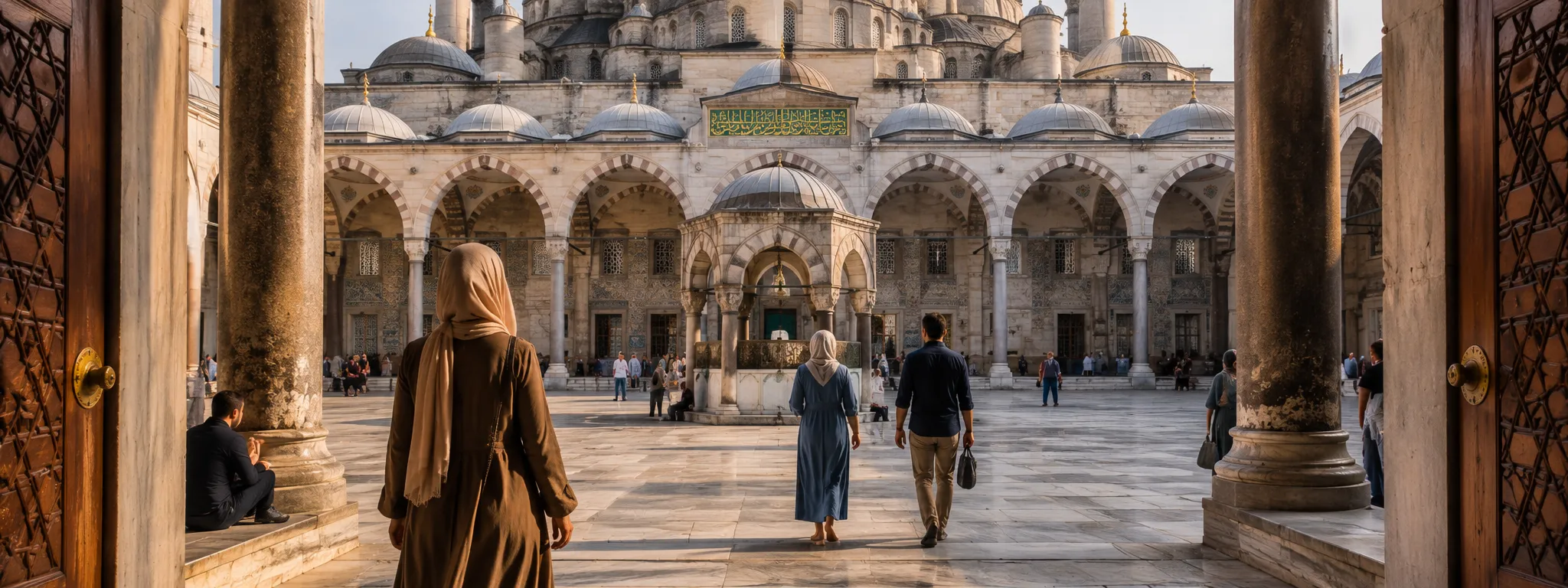
Visiting a mosque in Istanbul is straightforward when you remember one thing: it is a place of worship first and a visitor attraction second. You do not need to know every religious custom before entering. Dress modestly, remove your shoes where required, keep your voice down, follow staff instructions and give worshippers space. Those basics will carry you through almost every visit respectfully.
Active mosque or museum?
Istanbul contains both active mosques and historic buildings with museum-style visitor operations. The distinction matters. At an active mosque, prayer and community use can interrupt or restrict sightseeing. Hagia Sophia and the Blue Mosque, for example, are not ordinary museums where a purchased itinerary guarantees access at a precise minute.
Check the dedicated attraction page and current official guidance before visiting a major mosque, but once on site, follow the people managing the building rather than an old timetable on your phone.
Dress modestly
Diyanet's published visitor guidance says shoulders, arms and knees should be covered and female visitors should cover their heads. In practice, the exact way dress rules are implemented can vary by mosque and entrance. Some major visitor sites provide coverings, but it is easier and more respectful to arrive prepared.
Loose clothing is practical in hot weather. A lightweight scarf is useful for women who plan to visit mosques, and everyone should avoid clothing that is very revealing. You do not need to buy special religious clothing for an ordinary visit.
Remove your shoes
Shoes are removed before stepping onto the carpeted prayer area. Follow signs and local practice: some mosques have shelves, others provide bags or designated areas. Wear socks you are comfortable walking in and avoid leaving valuables in footwear.
If you are unsure where the shoe line begins, pause and watch rather than stepping ahead. The transition from stone or entrance mat to prayer carpet is usually obvious once you look.
Keep voices and phones quiet
Diyanet specifically asks visitors to maintain silence and silence or turn off phones. Treat the interior more like a place of worship than a busy gallery. Whisper if you need to speak, disable notification sounds and do not take a call in the prayer hall.
Children are welcome in many mosques, but families should help them understand the quieter atmosphere. If a child becomes distressed or very noisy, stepping outside briefly is considerate.
Photography is not automatically the priority
Photography rules vary. Diyanet advises visitors to photograph or record only with permission from mosque officials. Major visitor mosques may have their own posted rules. Never assume that because other people are holding phones, every form of photography is acceptable.
Do not photograph worshippers closely without permission, do not pose in a way that blocks prayer space, and do not use flash if it is prohibited or disruptive. A respectful visit is more important than reproducing a social-media shot.
Prayer times change the visit
Muslims pray five times a day, and congregational use takes priority. Visitor access may pause before, during or after prayer depending on the mosque. Friday midday prayer is especially important and can create longer restrictions and larger congregations.
The best strategy is flexibility. If entry is paused, visit another nearby sight, have tea or walk the neighbourhood and return later. Do not argue that a website promised access at a particular time.
Where should non-Muslim visitors stand?
Many famous mosques allow non-Muslim visitors in designated areas outside prayer periods. Follow barriers, signs and staff directions. During active worship, do not walk in front of people who are praying or weave through rows to get a photograph.
If you are invited farther into a space by staff or a local host, follow their guidance. Otherwise, staying within the visitor area is the respectful default.
Eating, drinking and cleanliness
Diyanet's visitor rules say not to eat or drink inside the mosque and to respect cleanliness. Finish snacks before entering and dispose of rubbish properly. Water arrangements may differ at large complexes, but do not treat the carpeted prayer hall like a café or rest stop.
Do not touch Qur'ans, religious objects or restricted furnishings simply for a photograph unless it is clearly permitted.
What about headscarves for men?
Men are not generally required to cover their heads to visit a mosque. The visitor dress expectation is modest clothing, including covered shoulders and knees. Women should carry a scarf or use a covering provided where available.
Rules at a specific mosque can be stricter than a general guide, so posted requirements always take precedence.
Can women visit mosques?
Yes. Women visit mosques as worshippers and visitors. Prayer arrangements may separate men and women or designate particular areas, especially during congregational prayer. Follow signage rather than assuming the main central carpet is a general visitor zone.
Men should show the same respect for women's prayer areas and should not enter spaces marked for women merely to look around.
Do you need to be Muslim?
No. Many Istanbul mosques welcome respectful non-Muslim visitors outside restricted worship periods. Diyanet's position on Hagia Sophia, for example, explicitly states that its doors are open to Turkish and foreign nationals, Muslims and non-Muslims, while emphasising mosque customs.
You are not expected to perform Islamic prayers or imitate worship. Quiet observation is enough.
What to do during the call to prayer
The call to prayer is not a signal for tourists to panic or immediately leave the street. Around a mosque, it means worship time is approaching. If you are already inside as a visitor, pay attention to staff directions because the visitor section may close or movement may be restricted.
Outside, simply avoid blocking entrances as worshippers arrive. Recording the call from a respectful public position is different from pushing into a doorway during the congregation's arrival.
Respect ablution areas
Many mosque complexes include fountains or facilities where worshippers perform ritual washing before prayer. These are functional religious spaces, not decorative water features. Do not sit in the way, splash around or photograph people closely while they are washing.
Historic fountains can be architecturally interesting, but give users priority.
Children and family visits
Families should not feel that mosques are forbidden territory. Choose a time outside major congregational prayer, explain the shoe and quiet rules before entering and keep the visit reasonably short. A child who understands what is expected usually finds the huge domes, carpets and calligraphy memorable.
Avoid forcing a long architectural lecture while a child is tired. One calm mosque visit is more respectful than dragging the family through five in a row.
Accessibility
Accessibility varies enormously between historic mosques. Main prayer halls may be reachable while galleries, courtyards or auxiliary spaces involve steps. Large active mosques may provide ramps or alternative entrances, but historic thresholds and crowded shoe areas can still be difficult.
If step-free access is essential, check the specific mosque rather than relying on general Istanbul advice. Staff can often indicate the appropriate accessible entrance.
How long should a visitor stay?
There is no required duration. Twenty to forty minutes is enough for many neighbourhood mosques; major monuments may deserve longer because of architecture and history. Do not linger in a way that blocks circulation or makes worshippers navigate around you.
If you want to study the building in detail, choose a quiet visitor period rather than the minutes around congregational prayer.
Common mistakes
- Treating an active mosque like a timed museum. Worship access comes first.
- Arriving in unsuitable clothing and arguing about the rule. Carry a scarf and dress modestly from the start.
- Walking onto carpet with shoes. Watch the threshold and follow signs.
- Photographing people at prayer. Give worshippers privacy and space.
- Talking loudly because the building is large. Sound carries under the domes.
- Blocking entrances around prayer time. Move aside and let the congregation enter.
- Copying what another tourist is doing. Follow staff and official rules instead.
Blue Mosque and Hagia Sophia
For the city's two most famous active mosques, use our current Blue Mosque guide and Hagia Sophia guide. They cover the visitor routing and practical differences that a general etiquette page cannot keep precise without becoming stale.
If you visit both on the same day, build flexibility into the schedule. The buildings face the same square, so a temporary access pause at one is easy to work around.
The simple rule
You do not need to be anxious about visiting a mosque. Be modest, quiet, observant and willing to follow local instructions. If you are unsure, ask a staff member politely or watch what respectful local visitors are doing. The aim is not to perform someone else's religion perfectly; it is to enter their place of worship with consideration.
Friday midday needs extra flexibility
Friday congregational prayer is the worst time to schedule a casual sightseeing visit to a busy mosque. Larger numbers of worshippers arrive, sermons and prayer take priority, and visitor access can be restricted for longer than at an ordinary daily prayer. If Friday is your only sightseeing day, put mosque interiors earlier in the morning or later once normal visitor management resumes.
That does not mean avoiding mosque districts on Friday. The surrounding squares and streets remain part of the city; just give entrances and congregations extra space.
What respectful curiosity looks like
It is fine to be curious about calligraphy, architecture, prayer practice or Islam. A mosque visit can be a chance to learn. Ask questions at an appropriate time and from people whose role includes helping visitors, rather than interrupting someone who is praying or leaving worship.
Most awkward moments disappear when visitors slow down, observe first and treat the building as somebody else's sacred space rather than an attraction they have purchased access to.