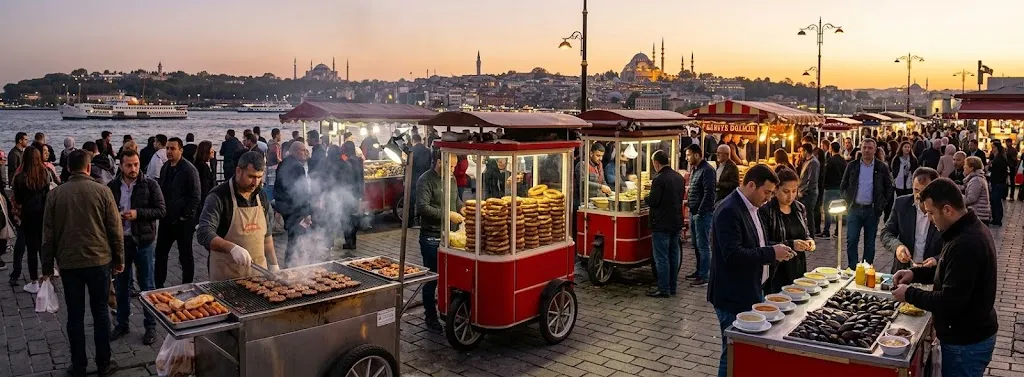
Istanbul street food is not a single cheap-eats category. It is breakfast on the run, ferry-pier snacks, late-night food after a meyhane, waterfront fish, bakery staples and neighbourhood dishes that make more sense eaten standing up than booked days ahead. The useful way to approach it is to know what each food actually is, where it belongs, and how to judge the seller without pretending one cart is permanently “the best”.
Simit: the easiest breakfast-on-the-move
Simit is a ring of bread coated in sesame, usually crisp on the outside and chewy inside. Red simit carts are part of the Istanbul streetscape, but bakeries and small cafés sell it too. It works best when fresh, with tea, cheese or simply on its own. For an early sightseeing start, it is one of the least complicated local breakfasts you can buy without sitting down.
Freshness matters more than a famous location. A cart turning over stock steadily in the morning is generally a better bet than one holding the same tray late into the day.
Balık ekmek: fish sandwiches belong by the water
Balık ekmek literally means fish bread: cooked fish served in bread, commonly associated with the Eminönü–Karaköy waterfront and the Golden Horn. The exact stalls and boats change over time, so I would not build the guide around one permanent vendor. Treat the waterfront atmosphere as part of the experience and compare a couple of busy sellers before ordering.
If fish quality or allergens matter to you, ask what fish is being served and do not assume every sandwich uses the same species or preparation. The dish is simple enough that freshness and turnover matter more than complicated toppings.
Midye dolma: stuffed mussels, usually eaten one after another
Midye dolma are mussels filled with seasoned rice and served cold or at ambient temperature with lemon. GoTürkiye describes them as a popular street-corner snack and specifically notes their late-night association with Taksim. They are typically sold by the piece, which makes it easy to try a small amount before deciding whether you want more.
Because shellfish handling matters, this is one food where I would be more selective than adventurous. Prefer a busy established seller with covered, orderly stock and high turnover; if anything about storage or cleanliness looks poor, move on.
Kumpir: Ortaköy’s overstuffed baked potato
Kumpir starts with a large baked potato whose interior is mashed with butter and cheese, then topped from a long counter of salads, pickles, corn, olives and other additions. GoTürkiye specifically points visitors towards Ortaköy, where the waterfront setting and rows of kumpir sellers make the dish part of the neighbourhood experience.
The useful trick is restraint. You do not need every topping just because it is available. Pick the ingredients you actually like, watch the potato being prepared, then eat it around Ortaköy Square or the waterfront rather than carrying it through a packed sightseeing route.
Döner, dürüm and tantuni: the fast-lunch category
Döner is meat cooked on a vertical spit and sliced to order; dürüm describes the wrap format rather than one specific filling; tantuni is finely chopped meat cooked quickly and commonly served in bread or a wrap. GoTürkiye’s street-food material treats these as core everyday options across the city rather than one-off attractions.
For döner, look for active turnover and meat being carved to order. For tantuni and other griddle foods, a busy counter where the food is cooked in front of you gives more useful information than an oversized tourist menu. If you want a full sit-down kebab meal, use a restaurant; street-food versions are best when you actually want something fast.
Tavuklu pilav and other cart food
Rice with chickpeas and chicken is another common cart-style meal. It is filling, straightforward and especially useful when you want something substantial without a long restaurant stop. You will also see roasted corn and chestnuts from carts, particularly when the weather suits them, plus baked goods, börek and small büfe snacks.
I would not publish fixed street-food prices here. Inflation and location can move them quickly. Check the displayed price or ask before ordering, particularly in the most visitor-heavy waterfront and nightlife areas.
What to order in Eminönü, Taksim, Ortaköy and Kadıköy
Eminönü/Karaköy: fish sandwiches, simit and quick ferry-side snacks make sense because they fit the waterfront. Taksim/Beyoğlu: midye dolma, döner, wraps and late-night food are easy to find. Ortaköy: kumpir is the obvious neighbourhood-specific choice. Kadıköy: use the market and surrounding streets for a wider food crawl rather than one mandatory dish.
The point is not that foods are legally confined to one district. It is that pairing the dish with the neighbourhood produces a better day than repeatedly crossing the city for a social-media “best of” list.
How to choose a street-food seller
Busy turnover is useful because food is moving, but a queue is not a hygiene certificate. Look for a clean preparation area, ingredients protected from obvious contamination, food handled with a sensible separation between money and serving where possible, and prices that are clear before you order. For shellfish or food that has been sitting out, be more conservative.
Also read the context: a tiny neighbourhood büfe with a short menu can be more reliable than a place trying to sell every Turkish dish at once. If a seller is aggressively pulling tourists in while the neighbouring businesses are quietly busy with locals, I would keep walking.
Vegetarian, allergy and dietary planning
Simit, kumpir and some bakery or corn/chestnut options can be vegetarian, but toppings, butter, cheese, cooking surfaces and fillings vary. Sesame is central to simit, dairy is standard in kumpir’s mashed base, and seafood is obviously a concern around midye dolma and fish stalls. Do not rely on a dish name alone for an allergy or strict dietary requirement.
Learn the ingredient you need to avoid, ask clearly, and choose a sit-down restaurant when cross-contact information is important. Street food is excellent for flexible eaters; it is not the place to make assumptions about a severe allergy.
A practical first-timer food crawl
For a low-effort introduction, I would start with simit and tea in the morning, use a ferry or waterfront walk to reach Eminönü or Karaköy for a savoury lunch, then try one late-afternoon or evening snack in the neighbourhood where you are already spending time. On another day, make Ortaköy’s kumpir or Kadıköy’s wider food scene the focus.
That gives you variety without turning every meal into research. Istanbul rewards curiosity, but the best food days still leave time to look at the city rather than spending hours commuting between saved pins.
Current source checked
Dish descriptions and neighbourhood context were checked against GoTürkiye’s current Istanbul street-food guide. Vendor line-ups, prices and individual business quality change, so I have deliberately kept this page focused on durable food knowledge and decision-making rather than permanent “best stall” claims.
Cheers, Carpe Diem & follow the appetite, not the algorithm! 🍻⏳🥙
TATS Man
eating Istanbul one sensible stop at a time