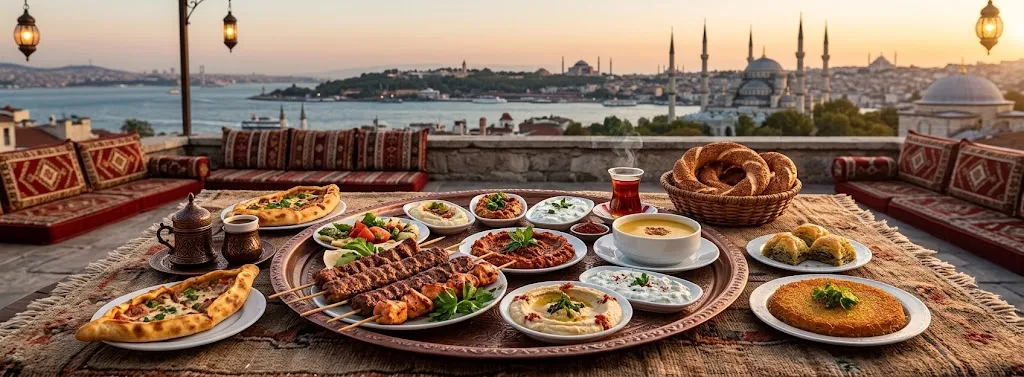
Turkish cuisine is far bigger than kebab, and Istanbul is exactly the city where that becomes obvious. GoTürkiye describes the city's food culture through neighbourhoods and experiences — lokanta meals, meyhane culture, breakfast, street food, sweets, Turkish coffee and tea — which is a much better framework than a “top ten foods” checklist.
Start with the restaurant type
- Lokanta / esnaf lokantası: prepared dishes, soups, vegetables, rice, stews and everyday home-style cooking; excellent for a quick lunch.
- Meyhane: meze-led social dining, often with fish and optional rakı; better for a long evening than a rushed meal.
- Ocakbaşı / kebab restaurant: charcoal-grilled meats, kebabs, salads and breads built around the grill.
- Kahvaltı salonu: breakfast-focused spreads or set breakfasts.
- Pastane / tatlıcı: pastries, puddings and sweets.
I would pick one format per meal instead of demanding that one restaurant perform the entire cuisine.
Meze is a meal structure, not just “Turkish tapas”
Meze can include cold vegetables in olive oil, yoghurt-based dishes, beans, seafood, cheeses and hot plates. At a meyhane it often becomes the centre of a long meal rather than a warm-up before a giant main course. Ask what is made that day and order gradually — a table of two does not need every plate in the display case.
Our Meyhane Culture guide goes deeper into the rhythm of the evening.
Rakı is traditional, but it is never compulsory
Rakı is an anise-flavoured spirit commonly associated with meze and fish. GoTürkiye lists it as part of the cuisine, but you do not need alcohol to have a legitimate meyhane-style meal, and not every restaurant serves it. If you drink, pace it with food and water rather than treating the cloudy glass as a challenge.
Kebab is a family of dishes, not one rotating spit
Döner is only one branch. Adana and Urfa-style minced kebabs, skewered şiş, grilled lamb and other regional preparations have different seasoning and textures. The useful question is what the kitchen or grill specialises in, not which generic “mixed kebab” photo looks largest.
For charcoal cooking, an ocakbaşı can be more informative than a restaurant trying to cover every tourist favourite at once.
Do not skip the everyday cooked-food counter
One of Istanbul's easiest good-value meals is the kind of food that rarely becomes an Instagram icon: soups, beans, stuffed vegetables, rice, vegetable dishes and stews from a lokanta. Pointing at the counter is normal. It is also one of the simplest ways to see how Turkish food works beyond grilled meat.
Breakfast deserves its own meal slot
A Turkish breakfast can involve bread, cheeses, olives, tomatoes, cucumber, eggs, preserves, honey, pastries and endless tea. Bigger is not automatically better: a huge “serpme” spread can create waste if two people are not hungry. Ask whether the breakfast is fixed, per person or à la carte before ordering.
See our Turkish Breakfast guide if you want the full decision tree.
Street food is strongest when you match the snack to the place
Simit is the classic sesame-crusted bread ring; balık ekmek is closely tied to the waterfront; midye dolma are stuffed mussels eaten with lemon; roasted chestnuts and corn appear from carts; döner and other wraps cover the fast-lunch slot. GoTürkiye treats street food as a core Istanbul experience, not a lesser version of restaurant dining.
Use the same food-safety judgement you would anywhere: high turnover, clean handling and properly hot food matter. Shellfish allergies and dietary restrictions deserve explicit questions, especially with stuffed mussels and shared preparation surfaces.
Coffee is ceremony; tea is the daily engine
Turkish coffee is unfiltered, brewed in a cezve and served in a small cup with the grounds left to settle. UNESCO recognises Turkish coffee culture and tradition as intangible cultural heritage. Fortune-reading from the grounds is a social tradition, but it is not the reason most people drink coffee.
Day to day, çay — black tea in small tulip-shaped glasses — is the more constant companion. You will encounter it at breakfast, shops, ferries, cafes and business meetings.
Sweets are a category, not an afterthought
Baklava is the headline act, but Istanbul also makes room for milk puddings, lokum, helva and syrup-soaked pastries. I would buy baklava from a specialist with fast turnover and choose the style and nut you actually like rather than assuming the most expensive box is automatically the best.
Our Turkish Desserts guide covers the sweet side in more detail.
Vegetarian is easy to find; vegan requires clearer questions
Vegetable dishes, lentil soups, olive-oil dishes, salads and meze create many vegetarian possibilities. Vegan travellers need to ask more carefully about yoghurt, butter, cheese, eggs and meat stock. A dish that looks plant-based from across the counter is not guaranteed to be vegan.
Use our Vegetarian & Vegan Istanbul guide for the more detailed phrases and planning.
Neighbourhood choice changes the style of eating
Kadıköy is excellent for market-driven wandering and casual food; Beyoğlu and Karaköy mix old institutions with newer restaurants and bars; the Historic Peninsula is convenient for sightseeing but rewards more selective restaurant choice. I would let the day's geography choose dinner rather than crossing the city for a viral address unless that restaurant is genuinely the point of the evening.
Ordering and payment without theatre
- Ask the price before ordering fish or other items sold by weight.
- If a display of meze is shown, confirm whether portions are full or half.
- For allergies, say the ingredient clearly rather than relying only on “vegetarian”.
- Check the bill before paying; extra tipping is voluntary rather than a fixed compulsory percentage.
- Do not mistake a persistent street tout for proof that a restaurant is popular.
Current sources checked
I checked GoTürkiye's current Taste Istanbul guide for the city's food categories and neighbourhood framing, plus GoTürkiye's Turkish Cuisine overview for meze, rakı, coffee and core dishes.
Cheers, Carpe Diem & order the meal type before chasing the famous dish! 🍻⏳🍽️
TATS Man
letting the lokanta, meyhane and ocakbaşı each do their own job