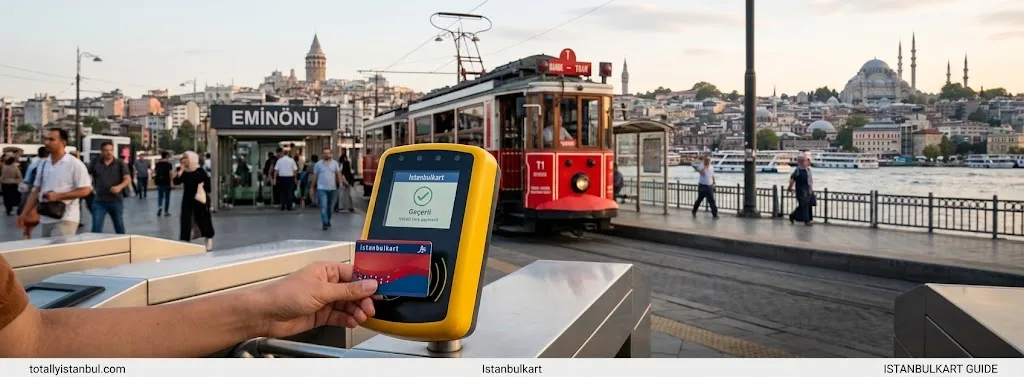
The Istanbulkart is the key to Istanbul’s integrated public-transport system. For most visitors it is the easiest way to pay for metro, tram, municipal buses, funiculars and many public ferry services without buying a separate ticket every time. The network is vast, but the payment idea is simple: obtain a card, load Turkish lira, tap at the reader and keep enough balance for the next leg.
What an Istanbulkart is
Istanbulkart is a reloadable contactless transport/payment card used across the city’s integrated transit network. Visitors normally use an anonymous card rather than the personalised discounted cards issued to eligible residents, students and other groups.
The card itself and the travel balance are separate things: buying a physical card does not necessarily mean it already contains usable credit. After purchase, check the balance and top it up before heading to the gate.
Current 2026 base fare
Metro İstanbul’s official “Tickets and Fares” page currently shows a 46.20 TL full fare for the anonymous Istanbulkart. It lists a 65 TL single-pass electronic ticket. These values reflect the current tariff at the time of our 30 August 2026 review.
Do not copy this number into a long-term trip budget months in advance. Istanbul’s transport fares can be revised during the year. Before travel, check Metro İstanbul’s official fare page for the current tariff.
Where to buy an Istanbulkart
Look for official Istanbulkart/Biletmatik vending machines at major metro, tram and ferry stations and transport interchanges. Airports also have public-transport ticketing points around their rail connections. Machine language options normally include English.
Avoid paying a large premium to an informal reseller just because you are tired after a flight. If a machine is confusing or out of cards, move to the next official machine or staffed transport point rather than buying from somebody hovering nearby.
How to top up
Use an official vending/top-up machine and follow the on-screen prompts. Payment methods vary by machine, so carrying some Turkish-lira cash remains useful even if you mainly use cards. The balance appears after taps and during top-up.
Load enough for the next few journeys rather than putting your entire holiday transport budget on one anonymous card. If you lose the card, an anonymous balance is not the same as money in a protected bank account.
How to tap correctly
At metro, tram and funicular gates, place the card against the reader until the display confirms the fare and opens the gate. On buses, tap the onboard reader as you enter. On ferries, tap at the terminal gate. Keep the card separate from other contactless cards to avoid read errors.
If a reader rejects the card, check the displayed reason before repeatedly tapping. The usual problems are insufficient balance or a temporary reader issue. Move aside so other passengers can pass, top up if necessary, then try again.
What Istanbulkart covers
- Metro: the backbone for longer cross-city trips and airport connections.
- Tram: especially the T1 line through Sultanahmet, Eminönü and toward Kabataş.
- Municipal buses: useful where rail does not reach, though traffic can make them slower.
- Funiculars: short connectors that save steep climbs, including links around Taksim/Kabataş.
- Public ferries: essential transport across the Bosphorus and one of the city’s best low-cost experiences.
- Metrobüs: high-capacity bus rapid transit, particularly useful for some cross-city routes.
- Marmaray: the rail tunnel and suburban corridor linking Europe and Asia beneath the Bosphorus.
Private cruises, airport coaches and other commercial services can use different ticket/payment systems. An Istanbulkart is not a universal pass for every vehicle in the city.
Marmaray and Metrobüs are not always flat-fare journeys
Some systems use distance-based charging rather than the simple base fare. That means a long Marmaray or Metrobüs journey can cost more than a standard metro/tram tap. On services with refund/exit validation arrangements, follow the station signage carefully.
This is another reason not to memorise a single “all Istanbul transport costs X” figure. The base fare is useful for planning, but the network includes special and distance-based tariffs.
Can tourists get transfer discounts?
Transfer rules depend on card type and current tariff policy. Personalised cards can have benefits that an anonymous visitor card does not. Do not assume a resident’s transfer-discount example applies to your anonymous tourist card.
The safest planning approach is to budget each leg at the full anonymous-card rate unless the official current rules specifically confirm a lower transfer charge for your card type. Any discount you receive is then a bonus rather than a budget hole.
Can several people share one card?
In many ordinary gate situations an anonymous card can be tapped multiple times for a small group, but sharing has trade-offs. Each person does not have an independent journey record, and any transfer or distance-based fare logic can become less straightforward. If you are staying several days and using transport heavily, one card per adult is usually cleaner.
For a family making only occasional rides, sharing may be convenient where permitted by the current system. Watch the reader after each tap and make sure every passenger has actually been charged before moving through.
Istanbulkart vs single-use electronic tickets
At the current official tariff snapshot, the anonymous-card base fare of 46.20 TL is lower than the 65 TL one-pass electronic ticket. But the card itself also has an acquisition cost, so the cheapest option for somebody taking only one or two rides is not automatically the same as for somebody using public transport all week.
Most city-break visitors take enough journeys that the reloadable card wins on convenience alone. It also removes the need to find and understand a new ticket product for every tram or ferry ride.
The T1 tram: the visitor workhorse
If you are staying in or visiting the historic centre, the T1 is likely to be your most-used surface line. It connects areas around Sultanahmet, Eminönü and the Galata Bridge with Kabataş and onward connections. It is efficient but can be extremely crowded.
During peak periods, keep bags zipped and move away from the doors after boarding. If you only need to travel one or two stops in the historic core, walking can be quicker than squeezing onto a packed tram.
Ferries: transport that doubles as sightseeing
Do not treat ferries as an optional tourist novelty. Scheduled public boats link European and Asian districts and can be the most pleasant part of a cross-city journey. Routes from Eminönü, Karaköy or Beşiktaş toward Kadıköy and Üsküdar give you Bosphorus views for an ordinary public-transport fare structure.
Use the Istanbulkart at the terminal gate and check the departure board. A commuter ferry and a private sightseeing cruise are different products; both can be worthwhile, but they solve different travel problems.
Airport trips: Istanbulkart helps, but plan the whole route
Istanbul Airport (IST) and Sabiha Gökçen (SAW) have rail connections, but the best route depends on your accommodation. Istanbulkart can be used on integrated urban rail, while airport coaches and commercial transfers may use separate fares or payment methods.
Do not judge an airport route only by map distance. Luggage, interchanges and station walking matter. For Sultanahmet, a rail journey can involve multiple legs; for accommodation near a direct metro corridor it can be much easier.
Using Istanbulkart in Sultanahmet
Once you reach Sultanahmet, many headline sights are within walking distance: Blue Mosque, Hagia Sophia, Basilica Cistern, Hippodrome and Topkapı Palace. Avoid reflexively tapping onto the tram for every tiny movement. Save transit for getting into the old city, crossing to Beyoğlu/Beşiktaş, reaching the Asian side or covering genuinely long distances.
Istanbul is hilly outside parts of the historic core, so funiculars and metro connections can save more energy than their short map distances suggest.
Top-up strategy for a short trip
Start with enough credit for a handful of rides, then top up as your travel pattern becomes clear. A visitor staying near Sultanahmet may walk more than expected; someone based in Kadıköy and sightseeing in Europe will use ferries and rail far more.
Check the remaining balance after taps. Running out at a quiet station is annoying but usually solvable; running out when your group is rushing for an airport connection is a self-inflicted problem.
Common Istanbulkart mistakes
- Assuming the physical card includes travel credit: verify and top up after purchase.
- Memorising an old fare: tariffs change; check the current official page.
- Confusing public ferries with private cruises: not every boat uses the same payment system.
- Expecting every service to be flat fare: Marmaray/Metrobüs and special services can price differently.
- Keeping zero buffer balance: top up before the last few lira disappear.
- Using transit for a five-minute Sultanahmet walk: the old-city core is often faster on foot.
Best apps and live information
Use official operator information for closures and fares, and a reliable mapping app for route planning. Metro İstanbul publishes line status and fare information; IETT operates the city bus network; Şehir Hatları publishes municipal ferry schedules. A route app is excellent for stitching modes together, but operator notices should win when there is a disruption.
Official fare source
For current prices, use Metro İstanbul — Tickets and Fares. At our 30 August 2026 check it listed 46.20 TL for the anonymous full fare and 65 TL for a one-pass electronic ticket. Re-check before publishing those numbers into your own fixed itinerary because fare revisions are common.