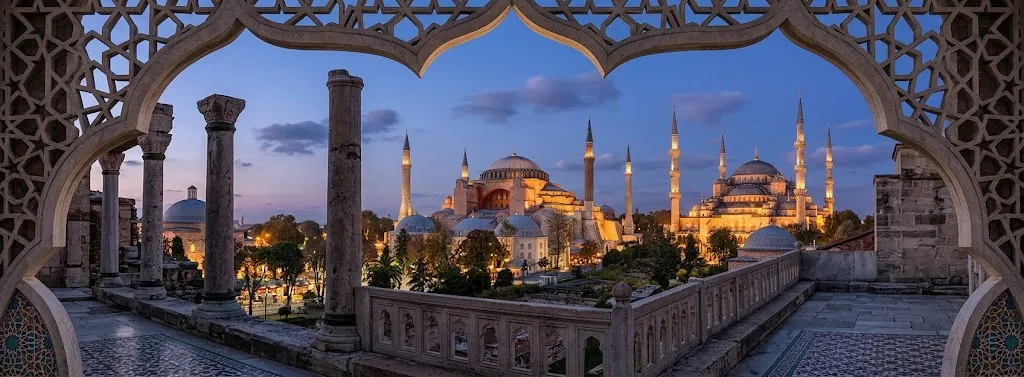
Sultanahmet is the compact historic core most first-time visitors picture when they think of Istanbul: domes, minarets, palace walls, Roman and Byzantine remains, and the broad former Hippodrome all packed into a district that can be explored largely on foot. It is also one of the easiest places to plan badly. The sights are close together, but queues, prayer access, security checks, museum fatigue and summer heat can make an overstuffed checklist feel much longer than the map suggests.
Why Sultanahmet matters
This small part of the Historic Peninsula contains layers from imperial Constantinople and Ottoman Istanbul in unusually close succession. Hagia Sophia, the Blue Mosque, Topkapı Palace, the Basilica Cistern and the Hippodrome area are not isolated attractions: together they explain how the city's ceremonial, religious and political centre changed over centuries. That makes Sultanahmet more rewarding when you treat it as one coherent district rather than a collection of photo stops.
If this is your first visit, give the neighbourhood enough time to look between the landmarks. The streets around Cankurtaran, Soğukçeşme and the palace walls, the small gardens and the views toward the Sea of Marmara add context that disappears when you rush from ticket gate to ticket gate.
The core sights and how to group them
The most efficient route begins around Sultanahmet Square. Hagia Sophia and the Blue Mosque face the same open space, while the Hippodrome monuments run immediately beside them. The Basilica Cistern is only a short walk away. Topkapı Palace sits beyond Hagia Sophia toward Gülhane and deserves a separate block of time rather than being squeezed in as another quick stop.
The Grand Bazaar is farther west near Beyazıt. It is walkable, but it works better as the end of a westbound route than as something you bounce to and from between Sultanahmet sights. If you want a market-focused day, pair the bazaar with Çemberlitaş, Beyazıt and the Spice Bazaar rather than repeatedly returning to the square.
Do not plan the mosques like museums
The Blue Mosque and Hagia Sophia are active places of worship, so visitor access can pause or change around prayers, religious observances and crowd management. Dress respectfully, follow staff directions and keep your itinerary flexible. The useful rule is simple: make one mosque your flexible anchor rather than scheduling both to the minute. If access is temporarily paused, visit the Hippodrome, the cistern or nearby streets and return later.
Our dedicated mosque pages carry the current visitor detail. A neighbourhood guide should not encourage you to rely on a stale opening-time screenshot or an old blog post when worship access can change.
Topkapı needs more time than it looks
Topkapı Palace is physically close to the square but functions more like a large museum campus. Courtyards, treasury rooms, views, the Harem and Hagia Irene can easily consume several hours, and security or popular interiors may slow the pace further. If the palace is important to you, put it in the first half of the day while your energy is high and leave the square-based sights for later.
A common mistake is trying to do Topkapı, Hagia Sophia, the Blue Mosque, the Basilica Cistern and the Grand Bazaar before lunch. The distances make that look plausible; the experience does not.
A realistic first-day route
- Start around Sultanahmet Square. Get oriented before committing to a queue.
- Use the first practical access window. Enter either Hagia Sophia or the Blue Mosque when it makes sense rather than insisting on a rigid order.
- Walk the Hippodrome. It is outdoors and works well between timed or controlled-entry sights.
- Visit the Basilica Cistern. It provides a change of pace and relief from heat or rain.
- Choose one major afternoon anchor. For many visitors that should be Topkapı Palace; for others it is a slower walk west toward the Grand Bazaar.
- Return to the square near dusk. The atmosphere changes noticeably after the largest day-tour groups leave.
Getting to Sultanahmet
Metro İstanbul's T1 Kabataş–Bağcılar tram stops at Sultanahmet and links the district directly with Sirkeci, Eminönü, Karaköy and Kabataş. That makes it the simplest rail approach from much of the European-side tourist corridor. At Sirkeci it connects with Marmaray and the T6 line; at Eminönü and Karaköy you can connect with ferries; at Kabataş the F1 funicular continues to Taksim.
The T1 is extremely useful but can be crowded. If you are staying around Eminönü or Sirkeci, walking may be just as sensible once you understand the hills and have light luggage. Taxis are rarely the best way to move between individual Sultanahmet sights because pedestrian space, traffic and road access work against short hops.
Walking conditions, hills and accessibility
The core square is comparatively easy, but the wider Historic Peninsula is not uniformly flat. Cobblestones, kerbs, gradients toward the water and crowded pavements can matter for wheelchairs, prams and anyone with limited mobility. Metro İstanbul describes the T1 stations as designed for low-floor tram access with ramps, which helps with reaching the district, but that does not make every historic street or attraction step-free.
Build in rests and check the dedicated attraction guide before assuming an old monument is fully accessible. For families, a compact day with fewer interiors usually works better than chasing a long list while carrying a tired child over uneven streets.
Where to eat without wasting the day
Sultanahmet has plenty of restaurants, but its most visible dining streets are heavily visitor-oriented. That is not automatically bad; it just means location and convenience often shape the offer. For a sightseeing day, a simple lunch close to your route can be more valuable than crossing the city for a famous meal.
If food is a major part of your Istanbul trip, save your more exploratory eating for Kadıköy, Beşiktaş, Karaköy or neighbourhood streets away from the monument zone. Around Sultanahmet, check menus before sitting down and be wary of anyone aggressively steering you into a restaurant or shop.
What Sultanahmet is like after dark
The district has a pronounced day-and-night split. Tour groups thin out, the square becomes calmer and the illuminated silhouettes around Hagia Sophia and the Blue Mosque are worth seeing without another ticket purchase. It is a good area for an evening walk, but not the city's strongest choice for bars, late-night dining or live nightlife.
If you stay here, you gain exceptional early-morning access to the historic sights. You trade away some of the evening variety you would have in Beyoğlu, Kadıköy or Beşiktaş.
Is Sultanahmet a good place to stay?
Yes for many first-time visitors, especially if your trip is short and the historic monuments are your priority. Being able to walk to the major sights before day-trip crowds build is a real advantage. It is also straightforward for travellers who prefer a quiet evening and do not mind eating in a tourism-heavy district.
It is less compelling if you want a neighbourhood feel, strong nightlife, contemporary restaurants or frequent late evenings elsewhere. Read our best areas to stay comparison before assuming the famous district is automatically the best base.
Best time of day to explore
Early morning is best for orientation and cooler walking. Midday is when crowd pressure and heat can be most tiring, so this is a sensible time for a shaded museum, the cistern or a deliberate lunch. Late afternoon into early evening is excellent for the square, palace-wall walks and photography as the day-tour rhythm eases.
In rain, prioritise indoor sights but expect queues to concentrate. In summer, carry water, use shade and resist the temptation to stack every outdoor walk into the hottest hours.
Common Sultanahmet mistakes
- Planning by distance alone. Close landmarks can still take hours once security, worship access and interiors are included.
- Repeating the same ground. Group sights geographically and keep moving in one direction.
- Trusting old opening or ticket information. Check the current attraction guide and official operator before a visit.
- Taking a taxi for tiny hops. The tram and your feet are usually more predictable inside the core.
- Spending every meal in the monument zone. Use Sultanahmet for history; explore other districts for more of Istanbul's everyday food life.
- Leaving no evening time. The neighbourhood is often at its most atmospheric after the busiest sightseeing period ends.
How long should you give Sultanahmet?
A half day is enough only if you choose two or three priorities. A full day works well for a first introduction. Two shorter visits can be even better: one serious sightseeing block and a separate early-evening return. If Topkapı Palace is a must-do and you enjoy museums, Sultanahmet can comfortably occupy more than one day without filler.
How Sultanahmet fits with the rest of Istanbul
Sultanahmet is essential, but it is not a complete picture of the city. Its streets are shaped by imperial monuments and tourism in a way that differs sharply from ferry hubs, residential districts and modern commercial areas. A first trip feels more balanced when you pair this district with at least one neighbourhood on the other side of the Golden Horn or Bosphorus.
Karaköy and Galata make an easy continuation once you are finished with the old city. Beyoğlu adds contemporary shopping, nightlife and late evenings. Kadıköy gives you a stronger sense of everyday Asian-side Istanbul. Beşiktaş puts the Bosphorus and ferries at the centre of the day. Thinking in contrasts makes Sultanahmet more meaningful rather than less important.
Photography, scams and respectful behaviour
The main square is one of Istanbul's most photographed places, but be considerate around worshippers and avoid blocking mosque entrances or pedestrian flows for a picture. Inside religious buildings, follow posted photography rules and never photograph people at prayer without clear permission.
The district's visitor density also attracts touts and sales approaches. Most are more annoying than dangerous, but a polite, firm refusal is enough. Be cautious if a stranger becomes unusually invested in directing you to a carpet shop, bar, restaurant or 'special' attraction. For wider city guidance, see our safety and common scams guide.