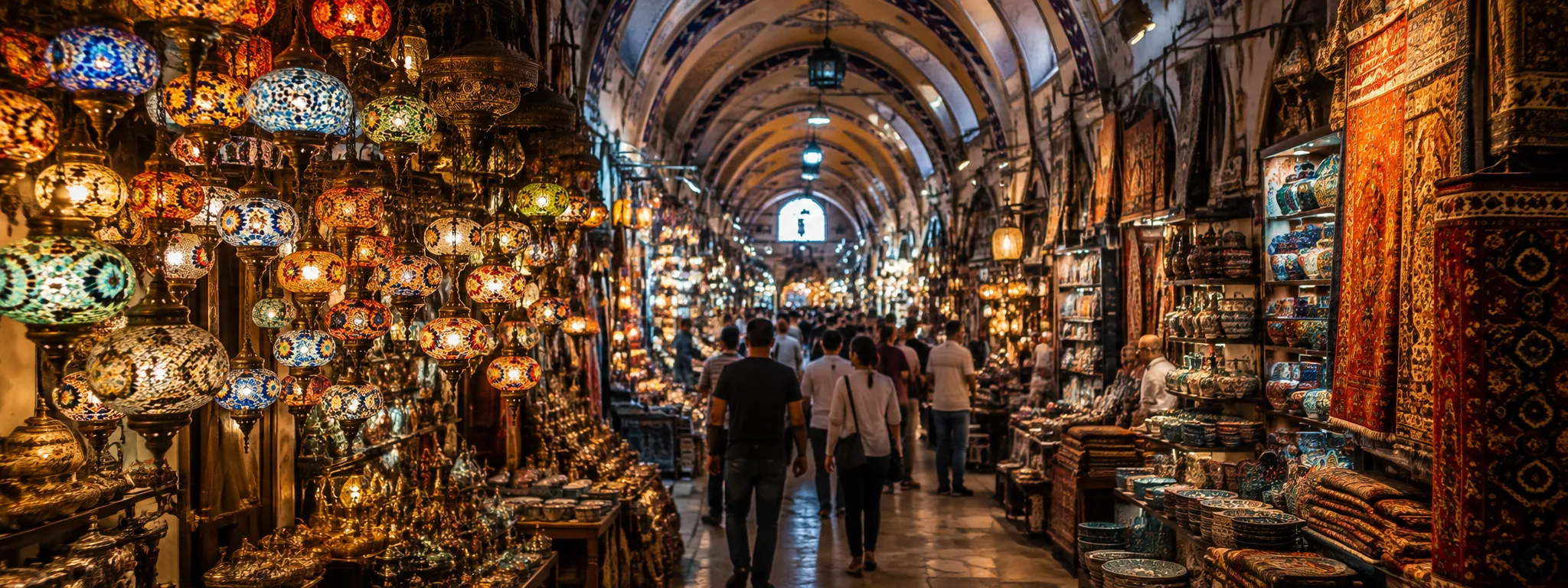
The Grand Bazaar is not one shop, one souvenir market or one neat rectangle you can “finish” in twenty minutes. It is a historic commercial district under a patchwork of roofs, with dozens of lanes, multiple gates, jewellery workshops, carpet dealers, leather shops, ceramics, textiles, antiques, cafés and businesses serving both visitors and Istanbul residents.
The useful way to visit is to choose a purpose before you enter: history walk, serious shopping, souvenir browse or a combination. If you simply follow the densest tourist flow, the Bazaar can feel repetitive. If you slow down, use the gates to orient yourself and compare several shops before buying, it becomes one of the most interesting commercial spaces in the city.
What the Grand Bazaar actually is
Kapalıçarşı — literally the “covered bazaar” — grew from the commercial foundations created after the Ottoman conquest of Constantinople in the 15th century. The historic bedestens at its core were secure trading buildings; surrounding streets gradually became organised around particular trades. Türkiye’s official tourism material describes the Bazaar as one of the world’s oldest and largest covered markets, with a network of roughly 61 covered streets and thousands of shops.
That history matters because the Bazaar is not a museum display. It is still a working commercial environment. Some lanes are intensely tourist-focused, while others retain jewellery, currency, textile and wholesale activity that feels much more like a functioning city market.
How long to allow
Allow 90 minutes to two hours for a first visit if you mainly want to wander, see the architecture and buy a few small things. Serious carpet, jewellery, leather or antique shopping can easily turn into half a day because comparison is part of the process. If you dislike crowds, a shorter purposeful loop is better than wandering until you are exhausted.
Do not schedule a timed attraction immediately after a shopping session. Negotiations, tea, payment and finding the correct exit can all take longer than expected.
Which gate should you use?
The Bazaar has many entrances. For a first visit, the most useful orientation is the axis between the Beyazıt side and the Nuruosmaniye side. Beyazıt puts you close to the T1 tram and Istanbul University area; Nuruosmaniye brings you toward Nuruosmaniye Mosque and the downhill route toward Çemberlitaş and Sultanahmet.
You do not need to memorise every gate. Save your entry gate on your phone, note a major landmark outside it and accept that getting mildly lost inside is part of the experience.
Getting there by tram and on foot
The T1 tram is the easiest public-transport approach for most visitors staying along the historic peninsula, Karaköy or Kabataş corridor. Beyazıt–Kapalıçarşı is the obvious stop for the western side of the market; Çemberlitaş is also useful for the eastern side and Nuruosmaniye approach.
From Sultanahmet, walking is completely reasonable if you are comfortable with hills and busy pavements. From Eminönü, the walk uphill through the commercial streets is fascinating but more strenuous than the map suggests.
When to go
The Bazaar is busiest through the central part of the day and on high-season weekends around the surrounding district. If your priority is photography, architecture and calm browsing, go earlier. If you want the full commercial buzz, late morning and afternoon deliver it — along with more crowding.
The covered market is normally closed on Sundays, and religious/public-holiday arrangements can differ. Opening information is exactly the kind of detail worth re-checking on the Bazaar’s official site immediately before your visit rather than relying on an old travel article.
A simple first-timer route
- Enter from the Beyazıt or Nuruosmaniye side.
- Walk one of the main commercial arteries toward the historic central bedesten area.
- Turn deliberately into quieter side lanes instead of staying on the most tourist-heavy corridor.
- Compare at least three shops if you are considering a meaningful purchase.
- Exit on the opposite side and continue toward Nuruosmaniye, Çemberlitaş or Beyazıt rather than trying to retrace every turn.
This gives you enough structure to avoid walking in circles while still leaving room to explore.
What is worth buying?
The Bazaar can be good for jewellery, textiles, leather, ceramics, metalwork, carpets and kilims, but quality varies enormously. “Made in Türkiye”, “handmade”, “antique” and “silk” are claims to verify, not decorative labels to accept automatically.
Small souvenirs are easy: compare finish and price, then buy what you like. High-value goods deserve a different mindset. Ask what the item is made from, where it was produced, whether there is documentation, what return options exist and how payment will be processed.
Carpets and kilims: slow the purchase down
Carpet shopping is one of the classic Grand Bazaar experiences, but it should never feel like a timed challenge. A good seller should be able to explain origin, fibre, construction, age where relevant and why one piece costs more than another. If the story becomes increasingly dramatic while the price collapses every time you stand up, treat the theatre as theatre.
For an expensive piece, sleep on the decision if you can. Photograph the item and shop details with permission, compare elsewhere and understand shipping, insurance and your home country’s import rules before paying.
Jewellery, gold and precious stones
The jewellery trade is a major part of the Bazaar’s commercial identity. For precious metals and stones, focus on weight, fineness, workmanship, documentation and the reputation of the seller rather than the excitement of bargaining. Ask for a proper receipt that identifies the item clearly.
If you are buying investment-grade gold or a high-value stone, do not treat a tourist guide as financial or gemmological verification. A pleasant shop experience is not a substitute for independent knowledge.
How bargaining actually works
Bargaining is common for many discretionary goods, but it is not a rule that every item must be reduced by a magic percentage. The sensible sequence is to establish that you genuinely want the item, ask the price, compare alternatives, make a reasonable counter-offer and remain prepared to leave.
Keep it friendly. Aggression and performative “hard bargaining” make the interaction worse. Equally, tea, friendliness and a long conversation do not create an obligation to buy.
Cash, cards and currency
Many established shops accept cards, particularly for larger purchases, while cash remains useful for smaller transactions. Before approving a card payment, check the amount and currency shown on the terminal. If a terminal offers to convert the amount into your home currency, compare that conversion with paying in Turkish lira rather than accepting it automatically.
Do not carry more cash than you need simply because you are visiting a market. Keep your wallet and phone secure in busy lanes, as you would in any major tourist shopping district.
Scams, pressure and quality problems
The Grand Bazaar is not inherently a scam, but the combination of tourism, high-value goods and unfamiliar products creates obvious opportunities for pressure selling. Walk away from claims that require immediate payment, secret “today only” investment opportunities, or goods whose supposed age/material cannot be explained coherently.
If you are unsure, leave. There are thousands of shops and no souvenir is worth turning a holiday into an argument.
Photography and shop etiquette
General street photography inside the Bazaar is part of the visitor experience, but a shop is still somebody’s workplace. Ask before photographing a person closely, a valuable display, a workshop or a detailed item you are not buying. Do not block narrow lanes or entrances for long photo sessions.
Tea may be offered during a sales conversation. Accepting it is not a contract. A polite “thank you, I’m still looking” is enough if you do not want to buy.
Accessibility and crowd comfort
The main covered lanes are generally much easier than Istanbul’s steep outdoor neighbourhood streets, but crowd density, thresholds, uneven surfaces and narrow shop entrances vary. Travellers using wheelchairs or mobility aids should favour the larger gates and main corridors and avoid building a visit around rapid movement through dense midday crowds.
For anyone sensitive to noise or crowds, arrive earlier, set a defined route and give yourself permission to leave before fatigue turns the experience sour.
Grand Bazaar or Spice Bazaar?
Choose the Grand Bazaar for a huge historic shopping environment, jewellery, textiles, carpets, leather and the experience of navigating a commercial labyrinth. Choose the Spice Bazaar for a smaller, more food-focused stop around Eminönü. They are different experiences and can be combined on the same day if you enjoy markets.
A good pairing is Grand Bazaar → Nuruosmaniye → downhill toward Eminönü and the Spice Bazaar. It turns shopping into a broader walk through the historic commercial heart of Istanbul.
What not to do
- Do not assume the first price is the citywide market price.
- Do not buy an expensive carpet, antique or gemstone because you feel socially trapped.
- Do not believe every “handmade”, “old” or “local” claim without asking questions.
- Do not rely on a fixed opening-hours screenshot from years ago.
- Do not spend the whole visit on one main lane and conclude the entire Bazaar is identical.
Official and authoritative sources
- Grand Bazaar management — official site and announcements
- Go Türkiye — Grand Bazaar history and visitor context
- Türkiye Culture Portal — Kapalıçarşı
Reviewed 31 August 2026. Re-check opening arrangements around Sundays, religious holidays and special events before travelling.