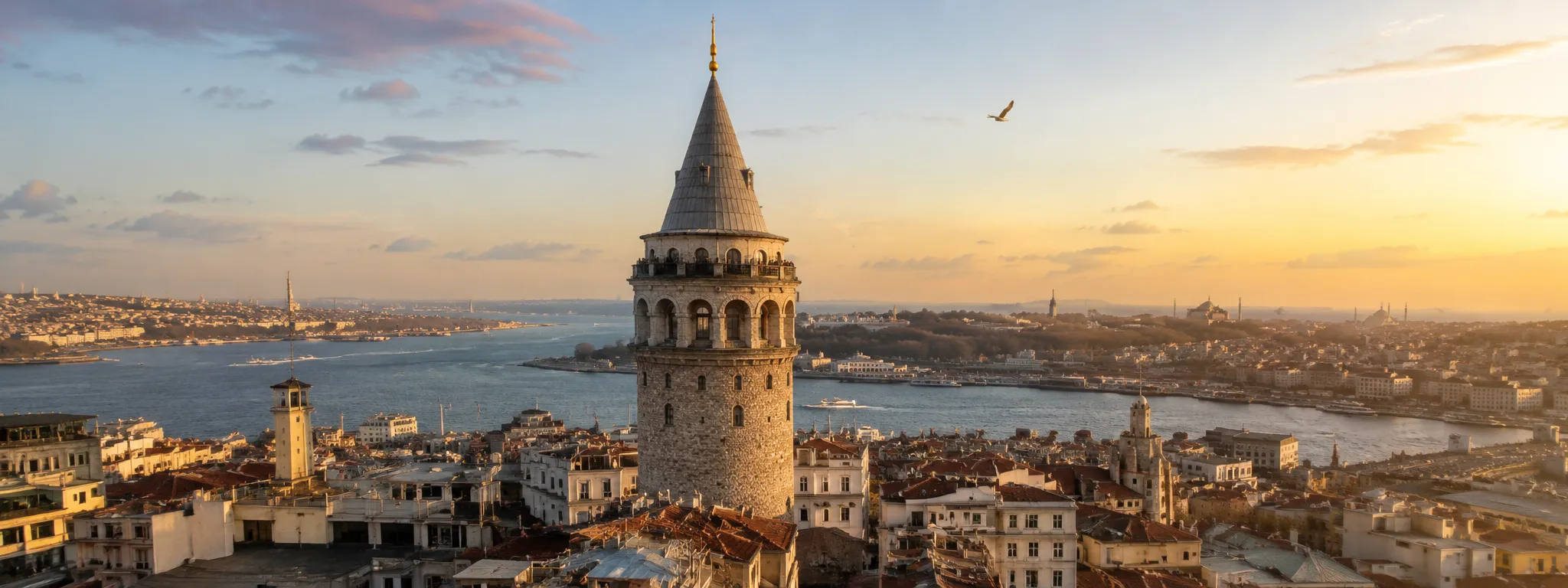
Galata Tower is Istanbul’s classic elevated viewpoint: a medieval stone cylinder rising above the steep streets of Galata, with a terrace panorama across the Golden Horn, historic peninsula, Bosphorus and modern city. The tower is now a museum as well as a viewpoint, so it is best approached as a short high-impact attraction rather than a place to spend half a day.
Why go up Galata Tower?
The view explains Istanbul’s geography better than almost any map. From the terrace you can trace the Golden Horn to the old city, pick out Süleymaniye and the Sultanahmet skyline, follow the Bosphorus toward Asia, and understand how Beyoğlu climbs behind Galata.
If you have already spent a few days walking the city, the experience is even better because landmarks stop being abstract shapes and become places you recognise.
A Genoese tower in an Ottoman city
The present tower dates to the Genoese period in the fourteenth century, when Galata was a fortified commercial colony across the Golden Horn from Byzantine Constantinople. Istanbul’s official visitor portal dates it to 1348. After the Ottoman conquest, the tower passed into Ottoman control and served different purposes over the centuries, including observation and fire-watch roles.
Its history is therefore not one neat “medieval tower” story. The building has been repaired, altered and re-purposed repeatedly, which is typical of Istanbul’s major monuments.
Tickets and museum access
Galata Tower is a Ministry cultural site, so use official Ministry/MüzeKart channels for current admission information rather than relying on an old travel article. Prices can move and special evening arrangements may carry different rules.
If you are considering MuseumPass Istanbul, confirm Galata Tower’s current inclusion on the official product page and compare the pass against attractions you genuinely intend to visit.
Night museum operation
The Ministry has continued a night-museum programme at Galata Tower, allowing visits into the evening. That creates a real choice: daylight for maximum geographic detail, golden hour for warm skyline colour, or night for illuminated mosques, bridges and waterfronts.
Sunset is naturally popular. If the exact moment matters, arrive well before it because queueing, security and internal circulation can consume the light you planned to photograph.
Best time for views
Clear mornings are excellent for long-distance detail and usually easier for photography than a packed sunset. Late afternoon gives richer light but more competition at the terrace. After dark, the city becomes more abstract and dramatic.
Weather matters more here than at an indoor museum. Low cloud, rain haze or strong wind can reduce the value of the ticket. If your itinerary is flexible, save Galata Tower for a clear window.
How long to allow
Allow around 60–90 minutes including entry, museum displays and terrace time. The actual viewpoint circuit is compact; queues are the unpredictable part.
Do not build a tight restaurant reservation immediately after the tower if you are targeting sunset. Leave room for delays and the slow walk down through busy Galata streets.
What you can see
Look south first toward the historic peninsula: the Golden Horn, Süleymaniye Mosque and the domed Sultanahmet skyline. Then turn east toward the Bosphorus and Asian shore. North and west reveal the dense modern fabric of Beyoğlu and the city beyond.
The view is strongest when you use it to connect places: identify Galata Bridge, trace the ferry routes, locate Topkapı’s green edge and see how steeply Beyoğlu rises from the waterfront.
The Hezarfen legend
One of the tower’s best-known stories is that seventeenth-century Ottoman figure Hezarfen Ahmed Çelebi launched from Galata Tower with wings and flew across the Bosphorus. The story comes through Evliya Çelebi and is part of Istanbul folklore, but it should be enjoyed as a famous historical account rather than treated as a modern independently verified aviation record.
Getting there without exhausting yourself
Galata is steep. From Karaköy waterfront, the walk is short but climbs sharply. The historic Tünel funicular can save energy by taking you uphill toward the southern end of İstiklal Avenue, after which you can walk down toward the tower.
From Sultanahmet, tram or ferry connections toward Karaköy make more sense than a taxi in heavy traffic. Walking across Galata Bridge is also a rewarding approach if the weather is good.
The square around the tower
The lanes immediately around Galata Tower are busy with cafés, souvenir shops, restaurants and constant pedestrian traffic. They are atmospheric but not necessarily where you will find the best-value meal.
After the tower, walk downhill through side streets toward Karaköy or uphill toward İstiklal rather than treating the tower square as the whole Galata neighbourhood.
Accessibility
The tower has modern visitor circulation but remains a historic vertical structure, and the final viewpoint experience can involve confined spaces, stairs and crowd management. Travellers with reduced mobility should check the current official accessibility procedure before buying a ticket.
The surrounding neighbourhood is also steep and has uneven paving, so transport planning outside the building matters as much as internal access.
Photography strategy
Use a wide lens for the Golden Horn/historic peninsula and a moderate zoom to isolate domes, bridges and ferries. Keep straps secure because the terrace can be crowded and windy. A phone is often ideal because you can move quickly without occupying scarce railing space.
At night, brace the device and use night mode rather than flash. The city, not the people beside you, is the subject.
Galata Tower vs rooftop bars
A rooftop bar gives a slower experience with food or drinks and may be better for couples who want to sit through sunset. Galata Tower gives a higher, more complete 360-degree geographic overview and historical context.
They are not interchangeable. If you only want the skyline and hate queues, a carefully chosen rooftop may suit you better. If you want the iconic tower itself and the broadest view, go up.
A good Galata half-day
Start in Karaköy, explore the waterfront and side streets, climb or use Tünel, visit Galata Tower, then continue toward İstiklal Avenue and Beyoğlu. In the opposite direction, finish at Galata Bridge and take a ferry from nearby terminals.
This works much better than travelling to the tower only for a 20-minute photo stop and immediately leaving the district.
Common mistakes
- Booking a sunset slot too tightly and missing the light in a queue.
- Going up on a hazy day when you could return in clear weather.
- Taking a taxi through central traffic for a journey better handled by tram/ferry/Tünel.
- Assuming an old ticket price is still current.
- Ignoring the rest of Galata and Karaköy once the tower is finished.
Current official sources
For context, see Visit Istanbul’s Galata Tower page. For current opening and ticket arrangements, verify the Ministry/MüzeKart system close to your visit.