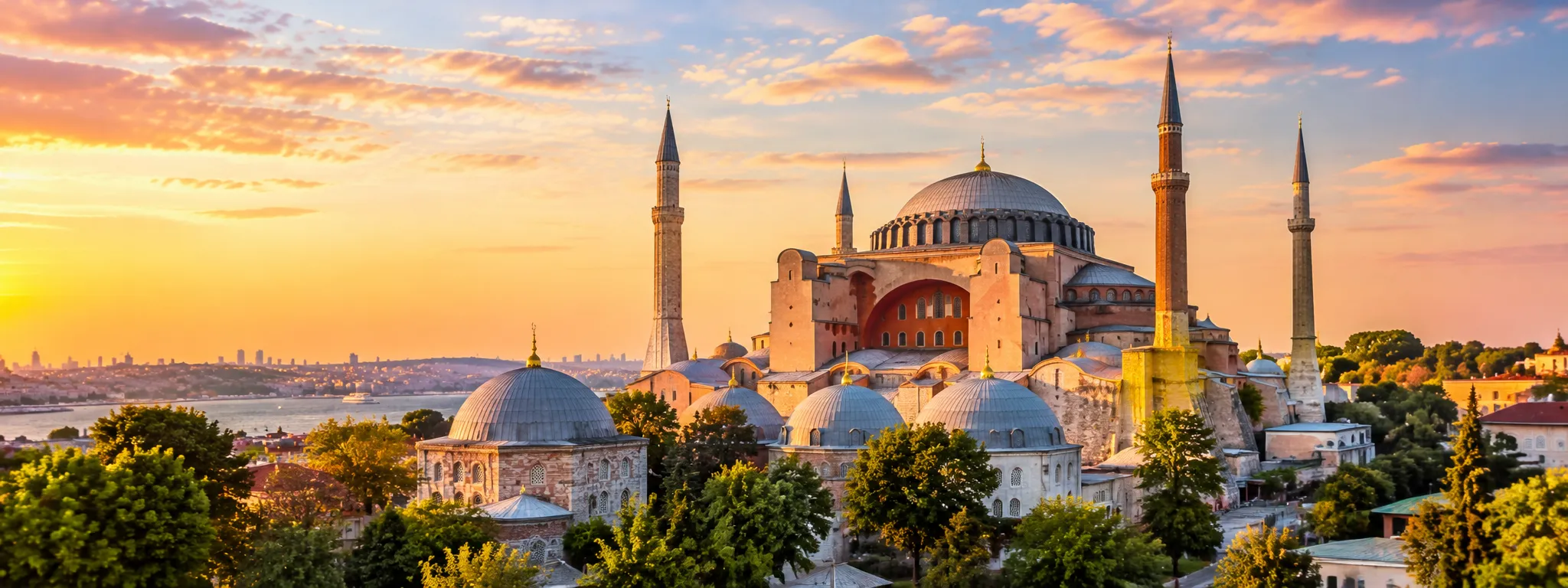
Hagia Sophia is the rare Istanbul landmark where a single visit forces you to think in several historical periods at once. Built as the great cathedral of Constantinople in the sixth century, converted into an imperial mosque after the Ottoman conquest of 1453, secularised as a museum in the 20th century and reopened for Muslim worship in 2020, it is now both an active mosque and a protected monument visited by people from around the world.
How tourist entry to Hagia Sophia works now
The most important change for travellers is that the tourist route is no longer simply the same entrance and floor used by worshippers. The Ministry of Culture and Tourism introduced a visitor-management plan that separates foreign cultural visitors from people entering the mosque for worship. Tourists are directed through a dedicated entrance and up to the gallery level, where they can look across the main prayer hall and see important Byzantine and Ottoman features without disturbing worship below.
This is a better way to plan the visit than relying on old guidebooks that describe Hagia Sophia as if it were still operating as a conventional museum with free movement across the ground floor. The building’s function has changed, and the modern route reflects that.
The Ministry says the gallery route was equipped with protective measures, cameras, fire detection and an audio-information system designed to reduce noise. QR-based information is available in multiple languages, so bringing your own headphones can be useful.
Hagia Sophia ticket price in 2026
The Ministry’s current museum-and-site fee notice lists the standard full tourist ticket for Hagia Sophia at €25. Turkish-citizen and Müzekart-related categories use separate pricing arrangements, and the exact sales channel can affect which ticket category appears.
If you are a foreign visitor, avoid buying from unofficial street sellers simply because a queue looks long. Use the official Ministry of Culture and Tourism ticket information and authorised ticket channels. The tourist route is a high-demand attraction in one of Istanbul’s busiest squares, which makes it an obvious place for confusing third-party offers.
Check the current Ministry museum/site fee list before you go.
Is Hagia Sophia open every day?
Hagia Sophia is a functioning mosque, so thinking in terms of ordinary museum opening hours can be misleading. Tourist access has to coexist with five daily prayers, Friday congregational worship, religious observances, security controls, restoration work and exceptionally busy periods.
For that reason, we recommend treating any exact online “open from X to Y” claim as something to verify on the day rather than a permanent promise. Build flexibility into the schedule, especially on Friday around the main congregational prayer. If Hagia Sophia is temporarily paused for tourist entry, use the time for the Blue Mosque, Sultanahmet Square, the Basilica Cistern or the nearby Hagia Sophia History and Experience Museum rather than waiting without a plan.
The upper gallery: what you actually see
The upper-gallery route changes the visual experience. Instead of standing beneath the central dome on the prayer floor, you look across and down into the enormous interior from above. That elevated viewpoint is excellent for understanding the geometry of the building: the central dome, supporting semi-domes, galleries, piers and the layered relationship between Byzantine structure and Ottoman additions become easier to read as a whole.
Tourists can also encounter surviving Byzantine mosaics in the gallery zone. The Ministry’s visitor-management announcement specifically highlighted the Byzantine mosaics and the ability to view the mosque’s main prayer space and Ottoman-period additions from the gallery.
The route is controlled rather than free-roaming. That means the visit is less about choosing your own path and more about using the available sightlines well. Slow down at the broadest viewpoints instead of treating the gallery as a corridor to be completed.
Why Hagia Sophia is architecturally extraordinary
The present building was commissioned by Emperor Justinian I and completed in 537. Its central dome, apparently floating above a ring of windows, was an engineering and aesthetic achievement that reshaped the architectural imagination of the Byzantine world. The structure combines a longitudinal basilica with a vast domed central space, using pendentives to transition from the square below to the circular dome.
The building has survived earthquakes, repairs, political upheaval, liturgical transformations and major changes in the city around it. What you see today is therefore not one untouched sixth-century object but a monument that has been repaired and adapted repeatedly across nearly fifteen centuries.
Byzantine mosaics: what to look for
Hagia Sophia’s mosaics are among its most important surviving Byzantine artworks. Some were created in different centuries, and their survival reflects the building’s complicated history through Iconoclasm, later Byzantine restoration, Ottoman conversion and modern conservation.
On the gallery route, pay attention to figurative mosaics that survived in the upper level, including imperial and devotional imagery. Visibility can change because conservation and the mosque’s religious function sometimes require temporary coverings or route adjustments, so do not build the entire visit around seeing one specific mosaic.
The better approach is to understand the mosaics as part of a wider layered interior where Christian iconography, Islamic calligraphy, architectural repair and changing religious use all coexist.
Ottoman layers: do not treat them as additions to ignore
After the conquest of Constantinople in 1453, Hagia Sophia became an imperial mosque. Over the following centuries the Ottomans added minarets, structural buttressing, a mihrab, minbar, calligraphic elements and associated buildings. Major Ottoman architects, including Mimar Sinan, were involved in strengthening and adapting the complex.
The huge circular calligraphic panels are among the most visually dominant Ottoman features inside. Rather than mentally separating “Byzantine Hagia Sophia” from “Ottoman Hagia Sophia”, look at how the building’s second major religious life changed its acoustics, visual hierarchy and relationship with the surrounding city.
Mosque etiquette and dress
Hagia Sophia is not only a monument; it is an active place of Muslim worship. Dress and behaviour should reflect that. Shoulders and knees should be covered, and clothing should be respectful rather than beachwear. Women should be prepared to cover their hair where required for mosque access. Follow the instructions of staff because the exact tourist route and separation from worship areas can change.
Keep your voice low, avoid obstructing people who are praying, and do not treat worshippers as photo subjects. The tourist gallery reduces direct interaction with the prayer floor, but respectful behaviour still matters throughout the building.
Photography rules may be tightened temporarily around restoration, security or worship. Flash, tripods and intrusive equipment are especially poor choices in a busy religious monument.
Friday prayer and religious timing
Friday is the day when planning matters most. The main congregational prayer attracts a large number of worshippers, and access arrangements around the mosque and Sultanahmet square can become more controlled. If Hagia Sophia is a major priority, visiting on another day can make the experience more predictable.
During Ramadan and major religious holidays, the building’s religious role becomes even more prominent. Tourist access still exists, but worship naturally takes priority. Check local prayer times and be willing to shift the visit rather than forcing a museum-style timetable onto a functioning mosque.
How long should you allow?
Allow roughly 45–75 minutes for the tourist gallery itself, plus time for ticketing and security. Architecture enthusiasts can easily spend longer because the gallery view rewards patient observation. Travellers moving quickly through a highlight itinerary may finish sooner, but queues can make total elapsed time much longer than the interior visit.
If you also visit the separate Hagia Sophia History and Experience Museum, allow another hour or more. It is a different attraction in a different building and should not be confused with the mosque itself.
The Hagia Sophia History and Experience Museum is separate
This is one of the easiest sources of visitor confusion. The Hagia Sophia History and Experience Museum is not the same thing as entering Hagia Sophia Mosque. It is housed in the historic Defter-i Hakani building near Sultanahmet and uses multimedia presentation plus museum objects to explain the monument’s Byzantine, Ottoman, museum and mosque phases.
The official Ministry listing currently shows that museum open daily from 09:00 to 20:00, with its ticket office closing at 19:00 and a €25 standard entry price. Those details belong to the Experience Museum, not automatically to the mosque tourist route.
If you want historical context before seeing the monument, doing the Experience Museum first can be useful. If you already know the history and have limited time, prioritise the actual Hagia Sophia gallery.
Best time of day to visit
Early morning is usually the safest strategy for crowd control, while late afternoon can sometimes be calmer after day-tour groups thin out. But prayer times matter more than generic “best time” formulas. The optimal window is one that avoids a major prayer transition and gives you enough time before your next timed attraction.
Do not book the Basilica Cistern, Topkapı Palace and Hagia Sophia back-to-back with zero flexibility. Security queues and prayer pauses are exactly the kinds of variables that make a tightly engineered Sultanahmet morning fall apart.
Combine Hagia Sophia with the Blue Mosque
The Blue Mosque stands directly across Sultanahmet Square, so the two monuments naturally belong in the same walking circuit. But they are both active mosques. Treating them as ordinary museums with fixed all-day tourist access is the fastest way to create frustration.
Check prayer timing, then visit whichever monument is accepting tourists first. Use the square, Hippodrome monuments and nearby cafés as buffers rather than standing in a closed queue. The physical distance is tiny; the scheduling complexity comes from worship, not transport.
Hagia Sophia and Topkapı Palace in one day
It is possible to pair Hagia Sophia with Topkapı Palace, but give Topkapı the larger block of time. A sensible plan is Hagia Sophia early, followed by Topkapı for the remainder of the morning and early afternoon, or the reverse if you have a timed palace ticket and can use Hagia Sophia more flexibly.
Avoid adding every major old-city attraction as well. Hagia Sophia, Topkapı, the Blue Mosque and Basilica Cistern can technically fit into a long day, but the result often becomes a queue-management exercise rather than a meaningful visit.
Accessibility and physical effort
The tourist route’s defining feature is the upper gallery, so travellers with limited mobility should verify current accessibility arrangements before relying on the standard route. Historic architecture places real constraints on lifts, ramps and circulation, and restoration work can change which route is available.
If stairs are difficult, contact or check the current official visitor information before arrival. Do not assume that accessibility arrangements described in an older blog post still apply during an active restoration programme.
Common mistakes to avoid
- Using an old museum guide. Tourist access now uses a dedicated gallery route.
- Confusing the Experience Museum with Hagia Sophia Mosque. They are separate attractions.
- Ignoring prayer times. Religious use can change tourist access during the day.
- Buying from the first unofficial seller you meet. Check Ministry pricing and official channels.
- Expecting free roaming on the ground floor. The modern visitor route is controlled.
- Dressing as if it were only a museum. It remains an active mosque.
- Scheduling a timed attraction five minutes later. Security and access pauses can make total visit time unpredictable.
A practical first-visit plan
Check the day’s prayer times before leaving your hotel, aim for a quieter morning window, and approach Hagia Sophia knowing that your cultural visit will primarily be an upper-gallery experience. Use the official ticket information, bring headphones if you want to use the QR audio interpretation, and dress for a mosque rather than a conventional museum.
Once inside, resist the urge to rush. Look across the prayer hall to understand the dome and semi-domes, then focus on the layered details: Byzantine mosaic, Ottoman calligraphy, the mihrab, minarets visible through windows, structural buttressing and the way successive eras have changed the monument without erasing everything that came before.
Hagia Sophia is most rewarding when you stop trying to decide whether it is “really” Byzantine, Ottoman, Christian, Muslim, museum or mosque. Its significance comes from the fact that all of those histories are present, contested and visible in the same building.
Official sources checked for this guide
The tourist-route structure and €25 cultural-visitor fee were checked against the Republic of Türkiye Ministry of Culture and Tourism visitor-management announcement and the Ministry’s current museum and archaeological-site fee listing on 30 August 2026. The separate Experience Museum details were checked against its official museum listing.