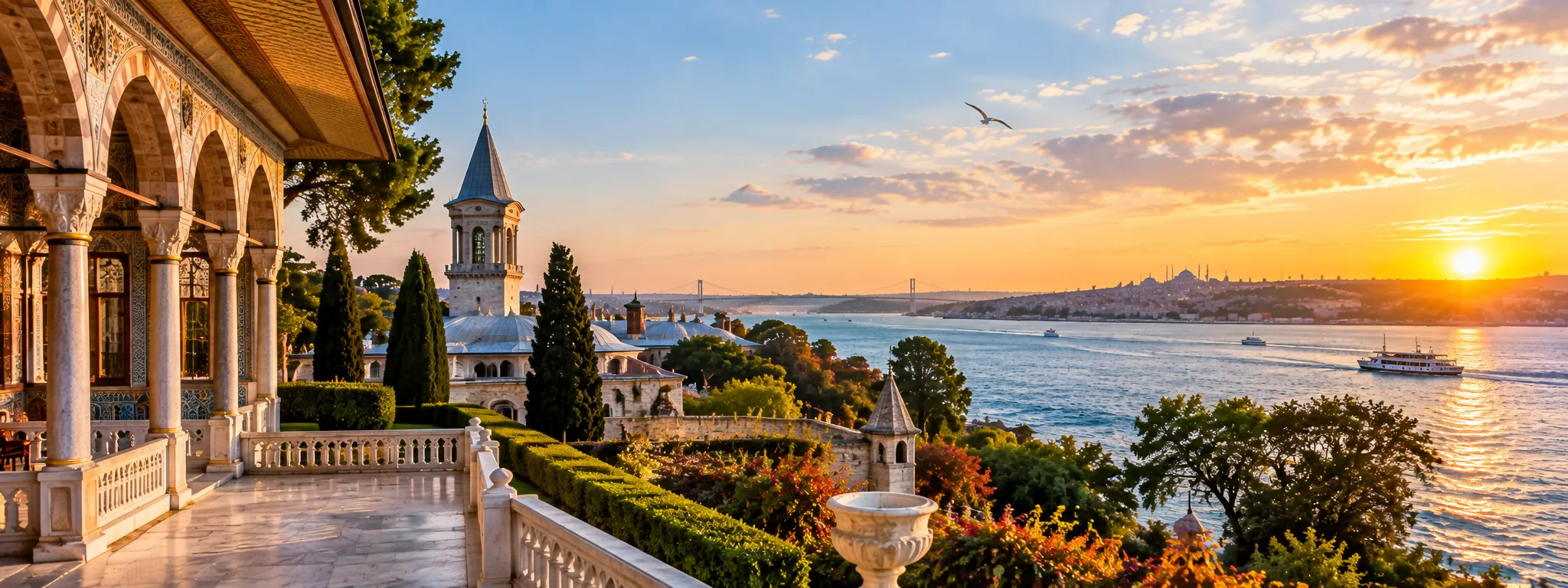
Topkapı Palace is the place where Istanbul's Ottoman story becomes physical. For almost four centuries it was not simply a royal residence but the working centre of an empire: a fortified complex of gates, courtyards, council rooms, treasuries, kitchens, gardens and private apartments overlooking the Bosphorus and Golden Horn. It rewards visitors who understand that it is not one huge palace building. The experience unfolds gradually, from public ceremonial space to increasingly restricted areas that once controlled access to the sultan.
Topkapı Palace tickets in 2026
For most international visitors, the simplest option is the official foreign-visitor combined ticket. At the time of our review it includes the main palace, Hagia Irene and the Harem and costs 2,750 TL. The National Palaces ticket system says e-tickets are single-use and valid for 90 days, while Topkapı combined tickets are valid for one day once used. Turkish citizens use a separate domestic ticket category.
The official tariff also lists the Harem and Hagia Irene separately. That matters if you are comparing passes or already hold a museum product, because the National Palaces guidance specifically notes that Museum Card coverage does not extend to Topkapı's Harem and Hagia Irene sections. Do not assume every Istanbul museum pass includes every part of the palace.
Check the official National Palaces ticket page before purchase, especially if your trip falls around a public or religious holiday.
Opening days and the best time to arrive
Topkapı's regular closed day is Tuesday. The official visitor listing currently shows the ticket office opening at 09:00 and closing at 17:00. Holiday arrangements can differ, and the palace authority publishes a separate calendar for national and religious holidays.
For a first visit, arriving close to opening is usually the strongest strategy. The palace is one of Istanbul's headline attractions, and the bottlenecks are not evenly distributed: security, the Treasury, the Harem and narrow exhibit rooms can feel much busier than the open courtyards. An early start gives you more control over the order of your visit and makes it easier to spend time in the rooms that matter to you.
How long should you allow?
Allow about three hours for a meaningful first visit, and closer to four if you want the Harem, Hagia Irene, major collections and gardens without rushing. A two-hour visit is possible, but it becomes a highlights sprint. Topkapı is better understood as a sequence of spaces than as a checklist of famous objects.
If your Istanbul schedule is tight, pair Topkapı with one nearby Sultanahmet sight rather than trying to cram Hagia Sophia, the Blue Mosque, Basilica Cistern and the palace into the same compressed morning. The palace alone involves substantial walking and standing.
Understanding the four courtyards
The palace's layout explains how Ottoman court life worked. Each gate historically moved a visitor into a more controlled zone, and each courtyard served a different function.
First Courtyard
The outer court was the most public part of the complex. Today it is the approach to the ticketed palace and contains Hagia Irene, one of the oldest surviving Byzantine churches in Istanbul. Even before you reach the inner palace, the scale of the walls and gateways makes clear that this was a political compound as much as a home.
Second Courtyard
This was the administrative heart of the palace. Here you find the Imperial Council area and the palace kitchens. The kitchens are especially useful for understanding the machinery of court life: feeding thousands of residents, officials and visitors required an enormous logistical system, and the collections help turn that abstract scale into something tangible.
Third Courtyard
Beyond the Gate of Felicity, the atmosphere changes again. This more private court is associated with the sultan's audience spaces, education and some of the palace's most famous collections. It is where many visitors concentrate their time because of the Treasury and sacred-relic rooms.
Fourth Courtyard
The final terraces and pavilions are among the best places to slow down. The views toward the Bosphorus, Golden Horn and Asian shore help explain why this promontory mattered strategically long before the Ottomans built their palace here. These gardens are also a useful decompression point after the denser museum rooms.
Is the Harem worth it?
Yes for most first-time visitors with enough time. The Harem is not an optional decorative wing; it was the private residential world of the dynasty and a major political environment in its own right. The surviving rooms, tiled corridors, courtyards and apartments reveal a different side of palace life from the formal administrative route.
The word “harem” has accumulated centuries of exoticised Western mythology. In practical terms, this was a highly structured household occupied by the imperial family, servants, officials and attendants, governed by hierarchy and protocol. Visiting the space helps replace the stereotype with a much more concrete understanding of how the Ottoman court functioned.
If you have only ninety minutes at Topkapı, the Harem may force uncomfortable trade-offs. If you have three or four hours, it is one of the sections we would prioritise.
The Imperial Treasury: what to look for
The Treasury contains the palace's most famous jewel-encrusted objects, including the Topkapı Dagger and the Spoonmaker's Diamond. The temptation is to treat these as isolated “must-see” objects, but they make more sense as displays of diplomacy, court ceremony, wealth and dynastic power. Give yourself time to look beyond the headline pieces.
This can be one of the more congested sections of the palace. If the room is packed when you first arrive, consider continuing through the complex and returning later rather than spending a large portion of your visit shuffling in a slow queue.
Hagia Irene: easy to overlook, worth adding
Hagia Irene sits inside the outer palace precinct and is included in the current foreign-visitor combined ticket. It predates the Ottoman palace by many centuries and is one of the city's most important surviving Byzantine religious buildings. Its comparatively restrained interior creates a strong contrast with the richly decorated Ottoman rooms nearby.
Because many visitors rush straight toward the palace gates, Hagia Irene can become an afterthought. If your ticket includes it, make deliberate time for it rather than discovering at the end of the day that you skipped an included monument.
What not to miss on a first visit
- The palace kitchens for the scale of court life and collections.
- The Imperial Council area for the administrative story of the empire.
- The Treasury for the most famous ceremonial objects.
- The Harem for the private dynastic world behind the public palace.
- Hagia Irene for the Byzantine layer beneath the Ottoman complex.
- The Fourth Courtyard viewpoints for the geography of the city and a slower finish.
A sensible route through the palace
There is no single perfect route, but a practical first-timer strategy is to move quickly through the opening spaces, prioritise one or two likely bottlenecks while the palace is quieter, then slow down as the complex opens into the later courtyards. If the Harem queue is modest, do it earlier rather than saving it for the final half-hour.
Keep some flexibility. Temporary room closures, restoration work and crowd-management changes are normal in a historic complex of this scale. A rigid minute-by-minute itinerary is less useful than knowing your top three priorities.
Accessibility and physical effort
Topkapı involves more walking than many visitors expect. The route crosses stone and paved courtyards, thresholds and historic interiors, with plenty of time spent standing. Some areas are naturally harder to adapt because of the protected historic fabric. Travellers with limited mobility should check current accessibility arrangements with National Palaces before visiting and allow extra time rather than planning the palace as a quick stop.
Comfortable shoes are not a cliché here; they materially improve the visit. In hot weather, the open courtyards can also add heat exposure between indoor sections.
Getting to Topkapı Palace
The palace entrance is in the historic Sultanahmet area, close to Hagia Sophia and the Istanbul Archaeological Museums. For most visitors staying around the old city or along the T1 tram corridor, public transport plus a short walk is simpler than a taxi. Road traffic in the historic peninsula can be slow, and vehicle access close to the monuments is constrained.
If you are arriving from the Asian side, a ferry to Eminönü or Karaköy followed by tram or walking can be both practical and scenic. Build in extra time for the uphill sections rather than judging the route only by map distance.
Topkapı Palace or Dolmabahçe Palace?
If you can visit only one and your priority is Ottoman imperial history, choose Topkapı. It covers the empire's classical court world and occupies one of the most historically layered sites in Istanbul. Dolmabahçe tells a later, 19th-century story of a court increasingly influenced by European palace architecture and ceremonial culture.
They are complementary rather than interchangeable. Seeing both creates a remarkably clear architectural narrative: Topkapı's courtyards and pavilions show an older imperial system, while Dolmabahçe's waterfront state rooms show how dramatically the dynasty's public image changed in its final century.
Common mistakes to avoid
- Turning up on a Tuesday without checking the closure calendar.
- Assuming a museum pass automatically covers the Harem and Hagia Irene.
- Budgeting only one hour and then spending much of it in queues.
- Focusing entirely on the Treasury and missing the palace's spatial story.
- Leaving the Harem until closing time.
- Trying to combine every Sultanahmet headline attraction into one rushed half-day.
Our recommended plan
Book through the official National Palaces system if you want to secure an e-ticket, arrive near opening, and give Topkapı the better part of a morning. Prioritise the Harem, Treasury and one or two collections, but make time for the Fourth Courtyard and views rather than treating the palace as a conveyor belt between display cases.
Most importantly, use the architecture itself as your guide. The sequence from public outer court to increasingly private imperial spaces is the palace's strongest exhibit. Once you see that pattern, Topkapı becomes much easier to understand than a simple list of rooms and jewels.
Reviewed 30 August 2026 against current Republic of Türkiye National Palaces visitor and ticket information.