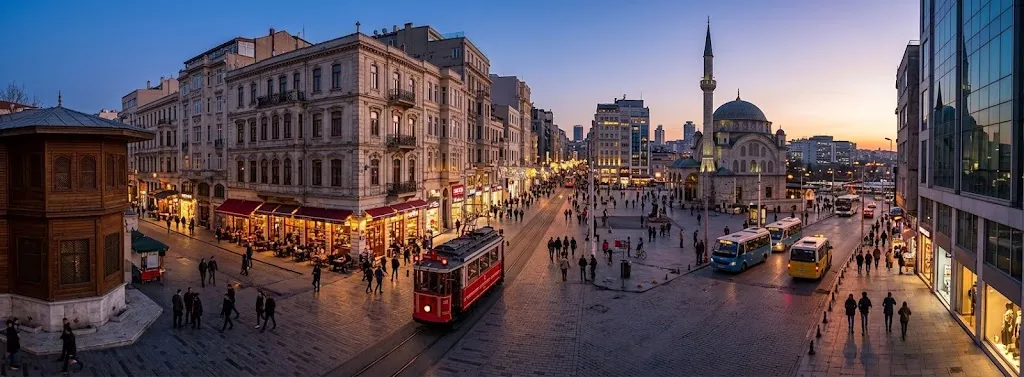
Beyoğlu is the Istanbul district for travellers who want the city after the monuments: busy streets, late dinners, music, galleries, historic passages, rooftop views and some of the easiest transport on the European side. Taksim Square is its best-known landmark, but the useful travel area is much larger — stretching from Taksim down İstiklal Avenue through Galatasaray and Pera to Şişhane, Galata and the slopes above Karaköy.
Why Beyoğlu feels different from Sultanahmet
Sultanahmet concentrates imperial monuments into a compact historic core. Beyoğlu is a living downtown layered over late-Ottoman and republican-era Istanbul. Its appeal comes less from one sequence of ticketed sights and more from the transitions between neighbourhoods: grand façades on İstiklal, church courtyards and old passages, steep Galata lanes, apartment streets around Cihangir, and modern nightlife around Taksim and Asmalımescit.
That makes Beyoğlu especially strong for repeat visitors, couples, solo travellers and anyone who wants evenings close to their accommodation. It is also useful on a first trip because the M2 metro, funiculars and nearby tram connections make it easy to combine with the historic peninsula, the Bosphorus waterfront and northern districts.
Think in clusters, not one giant neighbourhood
Beyoğlu is easier to enjoy when you split it into practical clusters. Taksim is the transport-and-orientation end. Central İstiklal and Galatasaray are best for passages, churches, food, shops and evening crowds. Pera and Şişhane are stronger for museums, hotels and a calmer historic-city atmosphere. Galata is steeper, more photogenic and more visitor-heavy around the tower. Cihangir is residential, café-led and better for wandering than sightseeing.
Distances on a map can look modest, but hills and crowds change the effort. A route that is comfortable downhill from Taksim towards Galata can feel much harder in reverse. Build the day around your mobility, weather and dinner plans rather than assuming every section should be walked twice.
Taksim Square: useful first, symbolic second
Taksim Square is the northern gateway to İstiklal Avenue and one of Istanbul's most important transport nodes. The square itself is open and functional rather than intimate, but it is a useful meeting point, orientation marker and starting place for a walk south through Beyoğlu. The Republic Monument and Atatürk Cultural Centre frame the space, while Gezi Park provides a greener edge immediately beside it.
Because Taksim is also a focus for public gatherings, demonstrations and occasional security-related transport closures, treat the square as a place where plans sometimes need to change. Metro İstanbul has repeatedly announced temporary Taksim/F1 closures on official orders during major events. If barriers, police activity or a large gathering appear, do not push through for sightseeing; use another station or route and follow current official information.
İstiklal Avenue: slow down and use the side streets
İstiklal Avenue is the pedestrian spine between Taksim and the Tünel/Şişhane end of Beyoğlu. The nostalgic red tram is part of the street's identity, but for visitors the real value is the network beside it: historic passages, churches, cinemas, bookstores, dessert shops, meyhanes, music venues and small streets that change character block by block.
The avenue can be extremely crowded, particularly in the evening and on weekends. Keep valuables secure, avoid stopping suddenly in the centre of the pedestrian flow, and step into a passage or side street when you want to check maps. The quieter details — façades, courtyards, arcades and backstreets — are easy to miss if you only march from one end to the other.
Historic passages and Pera
Beyoğlu's old passages are useful short breaks from the main avenue. Hazzopulo Passage, for example, is promoted by Istanbul's official visitor platform as a late-19th-century arcade with small shops and cafés. Passage d’Europe (Aynalı Pasaj) preserves another layer of the district's post-1870 rebuilding. These are not attractions that need a fixed timetable; they work best as detours while you are already exploring İstiklal.
The Pera/Tepebaşı side of Beyoğlu also gives you a calmer cultural base than the loudest parts of Taksim. It is a good area for travellers who want to walk to İstiklal but prefer sleeping one or two streets away from the heaviest nightlife. Check individual hotel streets carefully: a quiet-looking façade can still be close to a club, late bar or steep slope.
Galata and Şişhane
At the southern end, Şişhane is the practical rail gateway and Galata is the scenic draw. Galata Tower dominates the skyline, but the surrounding streets are the better neighbourhood experience: steep lanes, cafés, small design shops, historic apartment buildings and views towards the Golden Horn. The closer you get to the tower, the more visitor-heavy the streets become.
If the tower is a priority, use our Galata Tower guide for current ticket and entry planning rather than treating this neighbourhood page as a live timetable. If it is not a priority, you can still enjoy Galata by approaching from Şişhane, wandering downhill, seeing the Kamondo Stairs and continuing to Karaköy or the Galata Bridge.
Cihangir: cafés, slopes and residential atmosphere
Cihangir sits on the hillside south-east of Taksim and feels more residential than İstiklal. It suits travellers who like café mornings, apartment architecture and slower streets but still want Beyoğlu nightlife within walking distance. The trade-off is topography: reaching the waterfront or climbing back from Tophane can involve steep streets and stairs.
Cihangir is not a checklist neighbourhood. Pick a café, wander a few blocks, and treat the Bosphorus glimpses and street life as the attraction. It can also be a strong accommodation base for people who want evenings nearby without sleeping directly on İstiklal Avenue.
Getting to Beyoğlu by metro and funicular
For live rail planning, use Metro İstanbul. The M2 Yenikapı–Hacıosman line serves both Şişhane and Taksim, making it the main north–south rail spine for Beyoğlu. From the historic peninsula, M2 can be reached via Yenikapı or Vezneciler depending on where you start; for many visitors the T1 tram plus a funicular is more intuitive.
The F1 Taksim–Kabataş funicular is particularly useful for linking Taksim with the Bosphorus waterfront and the T1 tram at Kabataş. From Karaköy, the historic Tünel funicular climbs to the lower İstiklal/Şişhane area. These short vertical links matter because Beyoğlu is hilly — using them strategically can save far more energy than their short distance suggests.
Coming from Sultanahmet or Eminönü
From Sultanahmet, the simplest route depends on what part of Beyoğlu you want first. For Taksim, T1 to Kabataş plus F1 is straightforward. For Galata or lower İstiklal, T1 to Karaköy followed by Tünel or a walk uphill can make more sense. If the weather is good and you are comfortable walking, crossing the Galata Bridge from Eminönü gives you a memorable surface approach into Karaköy and Galata.
Do not choose a route only because an app shows the fewest minutes. Stairs, station exits, crowded platforms and steep streets can make a slightly longer rail connection easier in practice, particularly with children, luggage or limited mobility.
Nightlife: choose the right part of Beyoğlu
Beyoğlu has Istanbul's widest concentration of central nightlife, but 'nightlife in Taksim' is too vague to be useful. Around İstiklal and its side streets you will find bars, live music, clubs, meyhanes and late restaurants. Asmalımescit and Nevizade are denser and louder; Cihangir is more café-and-bar oriented; Pera can be more polished; Galata tends to mix visitor restaurants, rooftops and smaller bars.
Check menus, cover charges and event listings before committing to a venue. Avoid accepting persistent invitations from strangers to unknown bars or clubs, and do not let anyone separate you from your group or control the ordering without prices being clear. Istanbul is a major nightlife city, but the same common-sense rules you would use in any busy entertainment district matter here.
Safety, crowds and demonstrations
Beyoğlu is busy rather than inherently unsafe, but its density creates predictable issues: pickpocketing, phone distraction, taxi disputes, inflated tourist bills and opportunistic approaches around nightlife. Carry only what you need, keep your phone and wallet secure in crowds, and use official transport or reputable ride/taxi options rather than following someone to an unmarked car.
Taksim is also a recurring demonstration area. The current UK Foreign Travel Advice for Türkiye advises travellers to avoid demonstrations and follow local authorities. Emergency services in Türkiye are reached on 112. Treat those as planning basics, not reasons to avoid the neighbourhood.
Families and quieter visits
Families can enjoy Beyoğlu, particularly in daytime, but İstiklal's evening crowds can be tiring with small children. A daytime route from Taksim through one or two passages to Galata is easier than trying to combine shopping, dinner and late nightlife. Gezi Park and quieter side streets provide useful breaks from the pedestrian flow.
With a stroller, expect kerbs, paving changes and steep slopes. Metro and funicular stations may have lifts or escalators, but the street route beyond the station can still be the harder part. If mobility is a major concern, start high at Taksim and move gradually downhill rather than designing a route that repeatedly climbs between waterfront and ridge.
Accessibility and lower-mobility planning
Metro İstanbul publishes station facility information, and the M2 is generally the most useful accessible rail spine through Beyoğlu. Still, station accessibility does not make the whole district step-free. Galata and Cihangir contain steep streets, narrow pavements and occasional steps; crowded İstiklal can also be difficult for travellers who need more space.
A lower-effort plan is to choose one level: Taksim–İstiklal for a flatter central walk, or Şişhane–Galata with a downhill finish. Use F1 between Taksim and Kabataş rather than climbing the hill, and verify lift/escalator status on the day if a particular facility is essential.
Should you stay in Beyoğlu or Taksim?
Stay here if you value restaurants, bars, late evenings and fast metro access more than walking to Hagia Sophia or Topkapı Palace. Taksim is best for maximum transport convenience; Pera and Şişhane are often a better balance of atmosphere and access; Cihangir suits café-led neighbourhood stays; Galata works well if you accept hills and visitor traffic.
Light sleepers should avoid choosing a hotel only because it is 'near İstiklal'. Check the exact street, nearby venues and guest comments about noise. A property 150 metres from the avenue on a residential side street can feel completely different from one above a late bar. Compare these trade-offs with Sultanahmet and Kadıköy in our best areas to stay guide.
How long to spend
Allow three to four hours for a first daytime walk from Taksim through central İstiklal to Galata with one cultural stop. Six to eight hours gives room for lunch, a museum or gallery, slow side-street exploring and an evening meal. If nightlife matters, treat Beyoğlu as the evening anchor and keep the daytime sightseeing lighter so you are not exhausted before dinner.
Repeat visitors can easily split the district across multiple days: one evening around Taksim/İstiklal, one Galata–Karaköy walk, and another café-heavy session in Cihangir or Pera. That is a better use of Beyoğlu than trying to compress every sub-neighbourhood into one march.
A practical first-timer route
- Start at Taksim in late morning or early afternoon and orient yourself before entering İstiklal Avenue.
- Walk İstiklal slowly, choosing one historic passage, church, gallery or café detour rather than stopping at everything.
- Pause around Galatasaray or Pera for lunch and move away from the avenue if you want a calmer table.
- Continue towards Şişhane and Galata, using the downhill gradient to your advantage.
- Finish in Galata/Karaköy for dinner, or return towards İstiklal if nightlife is the main goal.
- Before staying late, check the live Metro İstanbul service and your return route.
Common mistakes to avoid
The biggest mistake is treating Beyoğlu as only Taksim Square and İstiklal Avenue. The side streets, Pera, Galata and Cihangir are where the district becomes more interesting. Another mistake is underestimating hills: a route that looks short can become tiring after several climbs. Do not build your evening around a remembered last metro or funicular; check live service. And do not follow persistent touts into venues where prices are unclear.
Finally, avoid scheduling Beyoğlu immediately after an exhausting full day of palaces and museums if nightlife is important to you. This is one of the parts of Istanbul that rewards spare energy. Give yourself enough time to eat slowly, wander without a destination and change plans when a street, passage or café looks better than the next item on your list.