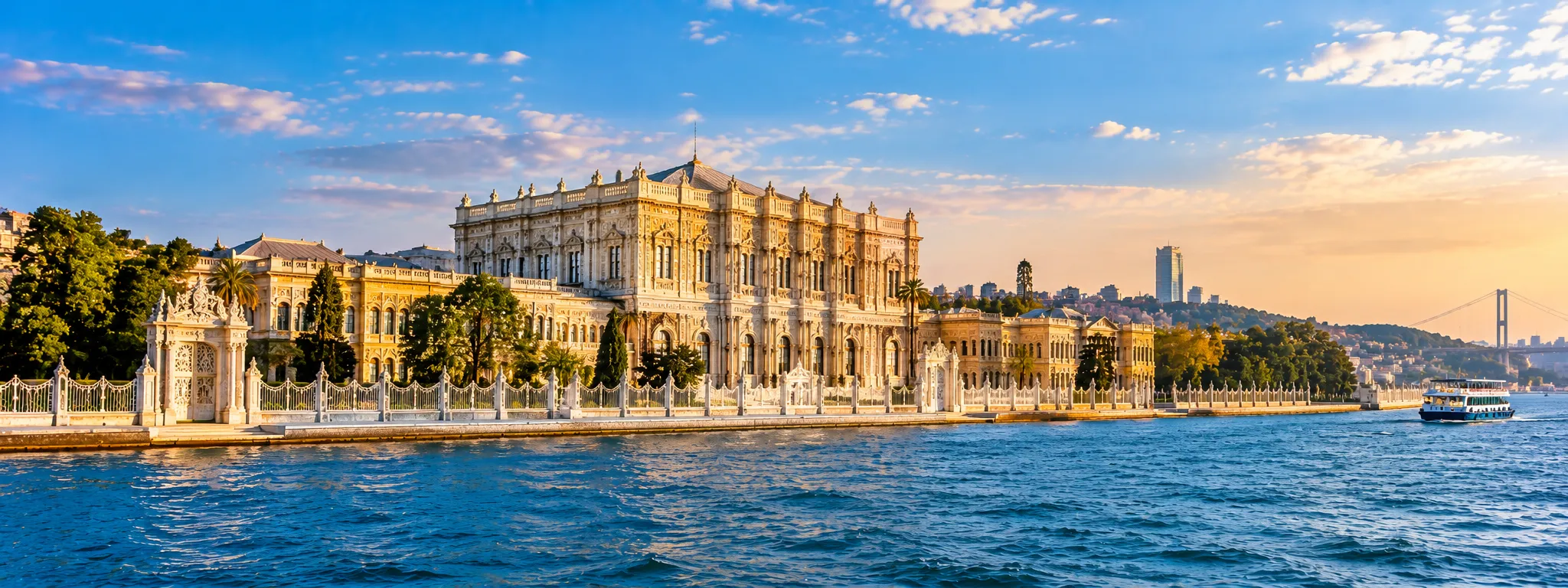
Dolmabahçe Palace is the clearest place in Istanbul to see how dramatically the Ottoman court changed in the 19th century. Topkapı Palace feels like an imperial city built through layers of courtyards, pavilions and restricted zones; Dolmabahçe is a single monumental waterfront statement, designed to receive ambassadors, stage ceremonies and present an empire that wanted to speak the architectural language of contemporary Europe without abandoning its own court traditions.
Dolmabahçe Palace tickets in 2026
The official National Palaces tariff currently lists a combined Dolmabahçe ticket covering the Selamlık (the formal administrative and state section), the Harem (the private residential section) and the Painting Museum. For foreign visitors, that combined ticket is listed at 2,000 TL at the time of this review. Domestic and discounted categories use separate pricing.
Do not assume that a general museum card covers the entire palace. National Palaces specifically notes that Müzekart is not valid in the Dolmabahçe Selamlık section. If you are using any pass or card, compare its current terms with the official palace ticket before you structure the day around it.
National Palaces also sells broader combined passes linking Dolmabahçe with other palaces, kiosks and pavilions. Those can make sense if you are deliberately building an Ottoman-palace itinerary that also includes places such as Yıldız or Beylerbeyi. They are less useful if Dolmabahçe is your only National Palaces visit.
Check the official Dolmabahçe Palace visitor and ticket information before purchasing.
Opening days and when to arrive
Dolmabahçe is normally closed on Monday. The official visitor page currently shows ticket offices opening at 09:00 and closing at 17:00. Public and religious holidays can have separate arrangements: some are open, while New Year’s Day and the first days of the major religious holidays are among the dates the official calendar lists as closed.
For most travellers, the best strategy is to arrive near opening. The palace interior is experienced through a fairly linear route, so crowding tends to accumulate rather than disperse in the way it can across Topkapı’s large outdoor courtyards. An early start also leaves room for the Painting Museum, gardens and the Bosphorus waterfront without turning the visit into a race against the ticket-office closing time.
How long should you allow?
Allow two and a half to three hours for a satisfying first visit. A faster traveller can see the principal interiors in roughly two hours, but that leaves less time for the Harem, exterior details, waterfront gates, gardens and the Painting Museum. If you are especially interested in late Ottoman history, decorative arts or Atatürk, three to four hours is easy to justify.
Dolmabahçe rewards slower observation. The palace is full of details that are easy to miss when you are moving only from “famous room” to “famous room”: ceiling painting, parquet, fireplaces, imported crystal, porcelain, carpets, furniture and the choreography of doors and sightlines all help explain how the building functioned as a state stage.
Why the Ottomans built Dolmabahçe
The site was once a natural bay on the Bosphorus. From the 17th century it was progressively filled — the name Dolmabahçe literally refers to a filled garden — and became an imperial waterfront garden. Earlier wooden palace buildings stood here before Sultan Abdülmecid commissioned the present complex in the 1840s.
Construction took place during the Tanzimat era, when the Ottoman state was pursuing major administrative and military reforms and engaging more intensely with European powers. The palace opened for imperial use in 1856. National Palaces credits the project to members of the Balyan family and other imperial building figures, and the result deliberately blends Ottoman planning traditions with Baroque, Rococo and Neoclassical decorative language.
That context matters. Dolmabahçe should not be read simply as “a European palace copied by the Ottomans”. It is more interesting than that: a late-imperial building using international architectural vocabulary to express a specifically Ottoman court and state.
Understanding the palace: Selamlık, Ceremonial Hall and Harem
The main palace is organised into three broad functional zones. The Selamlık was the administrative and formal state side, where government business and official receptions were handled. The Harem was the private residential world of the imperial family. Between them sits the enormous Ceremonial Hall, designed for state and religious ceremonies on a scale that could impress foreign dignitaries as well as domestic elites.
This division makes the route easier to understand. Instead of seeing a succession of extravagant rooms, ask what each space was designed to do: control access, stage authority, host diplomacy, separate public power from family life, or create a ceremonial transition between them.
The Ceremonial Hall: the palace’s great set piece
The Ceremonial Hall is the interior most visitors remember. Its huge volume, dome, columns and chandelier create an almost theatrical climax to the formal route. It is where the palace’s architecture is most explicitly about spectacle.
National Palaces describes Dolmabahçe as Turkey’s largest monoblock palace building, with 285 rooms, 44 halls, 68 toilets and six Turkish baths. Those statistics are striking, but the Ceremonial Hall translates the numbers into a physical impression: the palace was built to make scale itself part of the message.
Rather than rushing to photograph the chandelier, look at how the room works as a whole — the height of the space, the galleries, the light from the Bosphorus side, and the distance created between the central ceremonial floor and the edges of the hall.
The Crystal Staircase and decorative arts
The Crystal Staircase is another headline feature, but it is most useful as a symbol of the palace’s wider decorative programme. Glass, crystal, gilding, marble, parquet and textile were used in combination rather than as isolated luxuries. National Palaces highlights Hereke carpets, Baccarat crystal, Sèvres and Yıldız porcelain, diplomatic gifts and European paintings among the furnishings and collections.
Look beyond individual brand names and famous objects. The palace’s interiors reveal how the late Ottoman court curated status through imported materials, local craftsmanship and objects received through diplomacy. It is a political interior as much as a decorative one.
The Harem: more than a private add-on
The Harem is essential if you want to understand Dolmabahçe as a residence rather than only a reception building. Here the scale becomes more domestic and the story shifts toward the sultan’s family, household life and private circulation. The contrast with the public Selamlık is part of the point.
As at Topkapı, avoid the old exoticised idea that “harem” simply means a mysterious pleasure quarter. It was a regulated residential institution with its own hierarchy, rooms, routines and political significance. At Dolmabahçe, the Harem also helps show how older Ottoman concepts of household separation were adapted inside a much more European-looking palace form.
Atatürk’s room and the palace in the Republic
Dolmabahçe’s importance did not end with the Ottoman dynasty. Mustafa Kemal Atatürk used the palace during the Republican period and died here on 10 November 1938. The room associated with his death is preserved and carries deep emotional significance for many Turkish visitors.
National Palaces notes that Atatürk stayed at Dolmabahçe intermittently between 1927 and 1938, using it as a place of work as well as residence. The building then continued to have presidential functions into the İnönü era before opening as a museum-palace in 1984.
That history gives the visit an unusual arc. In one building you move from the final century of Ottoman monarchy into the foundational period of the Turkish Republic.
The Painting Museum: do not treat it as an afterthought
The current combined palace ticket includes the Painting Museum, housed in the former Crown Prince’s Apartments within the wider Dolmabahçe complex. It is easy to skip if you arrive with a palace-only mindset, but it adds a valuable layer to the visit.
The collection helps explain late Ottoman taste, court patronage and the growth of Western-style painting in the empire. If you are already interested in the palace’s European-facing architecture, the museum provides a natural continuation rather than a separate random attraction.
Allow at least 30–45 minutes if art is a meaningful part of your trip; more if you enjoy looking carefully rather than simply passing through.
Gardens, gates and the Bosphorus setting
Dolmabahçe is inseparable from the Bosphorus. The long waterfront façade and ceremonial gates were designed to be seen from the water as well as the land. Before leaving, spend time outside the main building and look back at the palace’s relationship with the strait.
The Gate of the Sultan, Gate of the Treasury, Clock Tower and waterfront gates are not merely decorative extras. They structure arrivals and reinforce hierarchy. The palace was a controlled landscape in which movement itself communicated status.
If the weather is good, the exterior is also the best place to reset after the density of the interiors. It is easy to underestimate how tiring several hours of slow museum walking can be.
Getting to Dolmabahçe Palace
The palace is in Beşiktaş, on the European shore of the Bosphorus. From Sultanahmet and the historic peninsula, the T1 tram to Kabataş followed by a walk is usually simpler than fighting road traffic. From many Asian-side neighbourhoods, a ferry to Beşiktaş or Kabataş creates a scenic and practical approach.
Beşiktaş ferry terminal is within walking distance, and the neighbourhood is well served by buses. If you are using a taxi, build in extra time around commuter peaks and major events; the waterfront roads can be slow even when the map distance looks short.
For a pleasant half-day, Dolmabahçe combines naturally with Beşiktaş, the waterfront, Yıldız Park or Ortaköy rather than with a second major Sultanahmet museum on the opposite side of the city.
Accessibility and physical effort
Compared with a sprawling archaeological site, Dolmabahçe may look straightforward, but the visit still involves long periods of standing and walking through a protected historic building. Historic thresholds, stairs and route controls can affect step-free access to particular areas.
Travellers with limited mobility should check current arrangements with National Palaces before arrival, especially if a specific room or section is important. Build a slower schedule and avoid pairing the palace with another physically demanding attraction immediately afterwards.
The surrounding Beşiktaş waterfront is relatively convenient for resting, cafés and onward transport once you leave the controlled palace route.
Dolmabahçe Palace or Topkapı Palace?
If your first priority is the classical Ottoman court, imperial collections and the empire at its long political peak, choose Topkapı Palace. If you are more interested in the 19th-century empire, European influence, ceremonial interiors and the transition toward modern Turkey, Dolmabahçe may speak more directly to you.
Ideally, visit both. They are not duplicate palace experiences. Topkapı is a sequence of courtyards, pavilions and layered access developed over centuries. Dolmabahçe is a consciously unified 19th-century waterfront palace. Seeing the two makes one of Istanbul’s biggest historical transformations legible through architecture.
Common mistakes to avoid
- Arriving on Monday. The regular closed day is easy to overlook.
- Assuming every museum card covers every section. National Palaces specifically excludes the Selamlık from Müzekart coverage.
- Budgeting only one hour. The formal route, Harem, exterior and Painting Museum deserve more.
- Skipping the Harem. You lose the residential half of the palace story.
- Ignoring the Painting Museum. It is part of the current combined ticket and fits the historical theme.
- Trying to combine Dolmabahçe with every Sultanahmet headline sight. Cross-city travel and museum fatigue quickly erode the day.
- Treating the palace as only a collection of luxury objects. The layout and ceremonial sequence explain as much as the chandeliers.
A practical first-visit plan
Arrive close to 09:00, buy or validate your official ticket, and begin the palace route before the biggest mid-morning crowds build. Give the Selamlık and Ceremonial Hall your fullest attention while you are fresh, then continue through the Harem rather than treating it as an optional afterthought.
After the main interior, slow down outside. Look at the gates and waterfront relationship, then add the Painting Museum if your energy and schedule allow. Finish in Beşiktaş for lunch or continue north along the Bosphorus rather than immediately commuting back across the historic peninsula.
Most of all, visit Dolmabahçe as the second chapter of Istanbul’s Ottoman palace story. The building becomes much more meaningful when you see it not simply as “the fancy palace by the water”, but as a deliberate 19th-century answer to the world that Topkapı represented.
Official source checked for this guide
Visitor information, ticket categories, opening arrangements and palace-history details were checked against the Republic of Türkiye Presidency of National Palaces — Dolmabahçe Palace and the official National Palaces e-ticket portal on 30 August 2026.