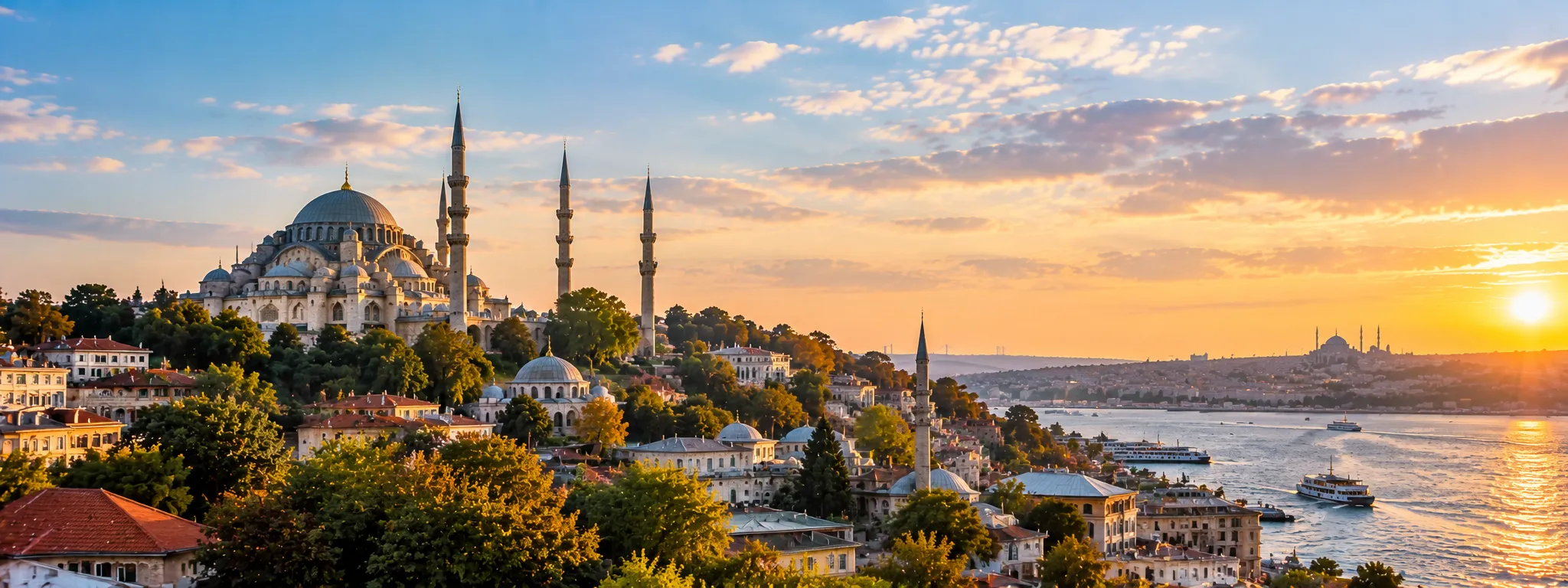
Süleymaniye is one of Istanbul’s great monuments and, for many repeat visitors, the mosque that best explains the city. It has the imperial scale of a major Ottoman complex without the same constant tour-group pressure as Sultanahmet. The building is still an active mosque, so the right way to plan a visit is around worship first and sightseeing second.
Commissioned by Sultan Süleyman I and designed by the imperial architect Mimar Sinan, the complex was built in the sixteenth century as a mosque, schools, charitable institutions and social facilities. The Republic of Türkiye Culture Portal records construction between 1551 and 1558.
Why Süleymaniye is worth your time
The interior is less tile-saturated than the Blue Mosque and more about proportion, light and structural calm. Outside, the elevated complex gives broad views toward the Golden Horn and Bosphorus. It is both an architectural destination and one of the best places to understand the Ottoman idea of a mosque as the centre of a much larger civic complex.
Admission and visitor access
Entry to the prayer mosque is free. Because it is an active place of worship, tourist access can pause around the five daily prayers and especially for Friday congregational prayer. Do not plan from a fixed “tourist timetable” copied from an old website. Check the current Istanbul prayer schedule through Diyanet on the day.
Dress and shoes
Cover shoulders and knees. Women should carry a scarf for the prayer area. Everyone removes shoes before entering the carpeted interior; use the bags or racks provided and keep valuables with you. Modest clothing is not a theatrical rule for tourists — it is basic respect inside an active mosque.
How long to allow
Forty-five minutes is enough for a focused visit, but an hour or more is better if you want to look at the complex and views. Add time if you are walking uphill from Eminönü or combining the visit with the Spice Bazaar.
Sinan and the imperial design
Mimar Sinan spent decades refining large-domed Ottoman mosque architecture. Süleymaniye is often treated as a defining middle-career masterpiece: a vast central dome, disciplined structural rhythm and carefully controlled light rather than decorative overload. The complex projects authority without feeling visually frantic.
The dome and interior light
Stand near the centre and look up rather than immediately photographing the walls. The dome rises above a broad, unified prayer hall, and rows of windows soften the sense of mass. The effect changes dramatically as daylight shifts.
What a külliye means
The original complex included education, charitable food provision, medical and service functions as well as worship. Some buildings have changed use, but the surviving ensemble still makes it clear that this was conceived as urban infrastructure, not an isolated monument.
The tombs
The complex contains the tomb of Sultan Süleyman and the tomb of his wife Hürrem Sultan, together with Sinan’s own modest tomb nearby. Treat these spaces as religious and funerary places, not just museum exhibits.
The terrace and views
The setting is one of the mosque’s great advantages. From the surrounding terraces you can read the shape of the Golden Horn, Galata and the waterways. Late afternoon light can be beautiful, but do not let a sunset plan make you careless about prayer access.
Getting there
The mosque sits uphill from Eminönü and the Spice Bazaar. The climb is manageable for many visitors but noticeable. Public transport gets you close rather than directly to the door, so allow extra time if mobility is limited.
Accessibility
The historic terrain and level changes around the complex can be more challenging than the prayer hall itself. Visitors who need step-free access should approach by vehicle as close as permitted and ask on-site staff for the easiest entrance rather than relying on the steepest walking route from the waterfront.
Photography
Quiet photography is normally possible outside prayer, but do not photograph worshippers intrusively, block movement or stage portraits in prayer rows. Put the camera away during congregational worship.
Best time to visit
A weekday mid-morning or mid-afternoon outside prayer periods usually gives the easiest experience. Friday around the noon congregation is the least sensible tourist window. Ramadan and religious holidays can change the rhythm of the site.
Combine it with Eminönü
A strong half-day is Spice Bazaar, a walk through the commercial streets, Süleymaniye, then tea or lunch before returning downhill. This is geographically coherent and gives you both living-city texture and an imperial monument.
Süleymaniye or Blue Mosque?
Do both if you can. The Blue Mosque has the famous six-minaret silhouette and İznik-tile interior; Süleymaniye has Sinan’s monumental planning, a larger social complex and a quieter hilltop setting. They explain different parts of Ottoman Istanbul.
Official source to check
For current prayer times use the Presidency of Religious Affairs (Diyanet). For historical and architectural background, the Republic of Türkiye Culture Portal is the strongest public source. Recheck worship access locally on the day.