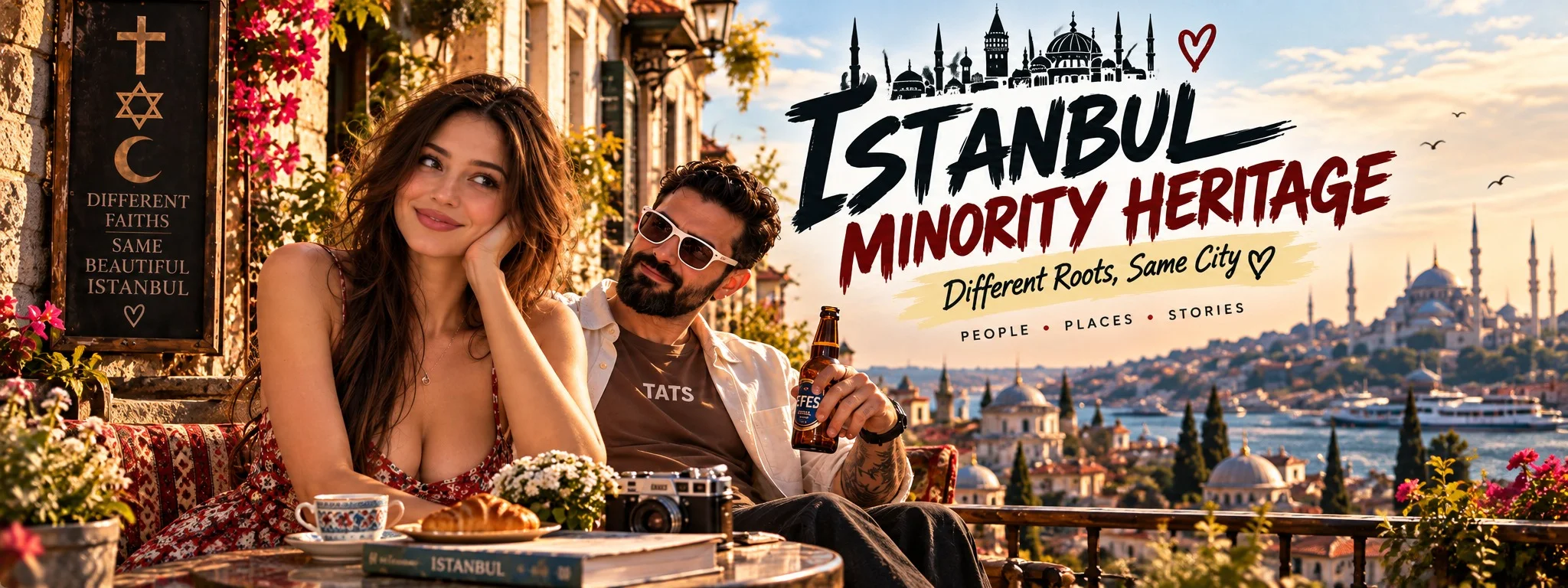
Istanbul makes more sense when you stop reading it as a two-act story of “Byzantine, then Ottoman” and notice the communities that lived between and across those labels. Greek Orthodox Christians, Armenians, Jews, Levantine Catholics, Syriac Christians and others helped shape the city's commerce, food, architecture, publishing and neighbourhood life. Some communities are much smaller today than they were a century ago, but that does not make their heritage extinct.
Start with a living-city mindset, not a “lost Istanbul” tour
Fener, Balat, Kuzguncuk, Galata and Karaköy are often marketed through nostalgia. That can be visually appealing, but it can also flatten very different histories into a vague story of “coexistence”. I would use the buildings to ask more precise questions: who worshipped here, who still does, which institutions remain active, and what twentieth-century events changed the population around them?
UNESCO describes Istanbul as a city whose exceptional value comes from layers of Roman, Byzantine and Ottoman history. The minority story sits inside that wider urban fabric rather than outside it.
Greek Orthodox Istanbul: Fener is still a religious centre
Fener remains the most important starting point because the Ecumenical Patriarchate of Constantinople is still based there at the Church of St George. This is not simply a monument from a disappeared community. It is an active church and the seat of an institution with global significance in Eastern Orthodoxy.
The city's Greek Orthodox population is far smaller than it was in the late Ottoman era. Population exchange, discrimination, the 1955 Istanbul pogrom and subsequent emigration all contributed to that decline. For a visitor, the useful takeaway is not a population statistic but the distinction between heritage and absence: liturgy, schools, foundations and community institutions still matter today.
Armenian Istanbul: continuity alongside profound loss
Istanbul remains the centre of Türkiye's Armenian community, with active churches, schools, newspapers and cultural institutions. A thoughtful route should recognise both that continuity and the catastrophic violence experienced by Armenians in the late Ottoman period.
The mass deportations and killings of Armenians in 1915–16 are recognised as the Armenian genocide by mainstream historical scholarship and institutions including the United States Holocaust Memorial Museum; the Turkish state rejects the genocide characterisation. A travel guide should not pretend that disagreement does not exist, but it should also not reduce a living Armenian community to one historical trauma. If you want to go deeper, use specialist historical sources rather than social-media summaries or a tour guide's improvised political argument.
Jewish Istanbul: Sephardic, Romaniote and modern community life
Istanbul's Jewish history includes older Romaniote communities and Sephardic Jews whose arrival expanded after the expulsions from Iberia at the end of the fifteenth century. Balat, Galata and later Beyoğlu all carry important Jewish layers, while active synagogues and community institutions continue elsewhere in the city.
Synagogue access is the place where I would plan most carefully. Security procedures can be stricter than at churches or mosques, and casual walk-in tourism should never be assumed. Check the current official museum or synagogue arrangements before travelling and carry the identification requested by the venue.
Fener and Balat: use one compact route, but do not blur the histories
For a first heritage walk, Fener and Balat are the easiest pair. I would begin around the Ecumenical Patriarchate, then walk slowly through the surrounding streets rather than racing between photo stops. The area contains Greek Orthodox, Jewish, Armenian and later Muslim layers, but not every colourful facade is evidence of one neat multicultural golden age.
Our Fener & Balat guide works well as the practical companion for hills, transport and route planning.
Kuzguncuk: a smaller-scale Asian-side contrast
Kuzguncuk is useful because churches, synagogues and mosques sit unusually close together in a compact Bosphorus neighbourhood. It is also a real residential district, so I would keep voices down around worship sites and avoid treating front doors, courtyards and residents as a film set. Pair the heritage walk with the waterfront and local streets rather than chasing a checklist.
See our Kuzguncuk guide for the transport and neighbourhood side of the visit.
Galata and Karaköy: merchant-city heritage beyond the postcard tower
Galata and Karaköy add another layer: Jewish, Greek, Armenian and Levantine merchant communities, European consular influence and the commercial life of the old port. The architecture makes more sense when you see these districts as trading neighbourhoods rather than merely the approach to Galata Tower.
I would combine this with our Karaköy guide and look for religious and civic buildings in context rather than building a route around one community alone.
Photography and worship etiquette matter more here
- Assume an active service takes priority over sightseeing.
- Ask before photographing people, worshippers, security areas or interiors where rules are unclear.
- Dress conservatively enough that you can enter a church or synagogue without creating a problem.
- Do not photograph security procedures or guards at sensitive religious sites.
- If access is denied or restricted, accept it and move on — community safety outranks a travel itinerary.
A half-day route I would actually use
- Start in Fener at the Patriarchate area.
- Walk into Balat, using the neighbourhood itself as the connective tissue rather than taxiing between monuments.
- Cross later to Galata/Karaköy for the merchant-city layer, or save Kuzguncuk for a separate Asian-side half-day.
- Leave enough time for a museum or institution where the community tells its own story, rather than relying only on exterior architecture.
Current sources checked
I checked UNESCO's Historic Areas of Istanbul for the city's layered heritage and Fener/Balat conservation context, and the United States Holocaust Memorial Museum for the 1915–16 Armenian history. Current access to active religious institutions should always be checked with the institution itself before visiting.
Cheers, Carpe Diem & read the streets as living history, not just colourful backdrops! 🍻⏳🕍
TATS Man
following the city's quieter layers with the volume turned down