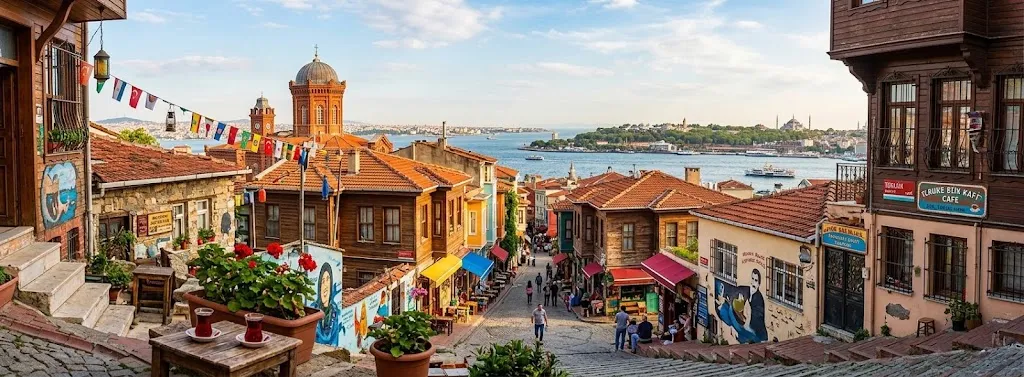
Fener and Balat are adjoining Golden Horn neighbourhoods known for steep streets, colourful façades, churches, synagogues, mosques and layers of Greek Orthodox, Jewish and Muslim history. They are also easy to reduce to an Instagram backdrop. The best visit looks beyond a handful of painted houses and treats the area as a living neighbourhood with residents, schools, worship sites and ordinary businesses.
Fener and Balat are not one single attraction
The names are often bundled together because visitors walk between them, but the neighbourhoods have different histories and landmarks. Fener is strongly associated with the Ecumenical Patriarchate and Greek Orthodox heritage. Balat has long Jewish associations alongside later Muslim and migrant communities. Their boundaries blur on a casual walk, which is fine; the important thing is not to flatten the whole area into 'colourful Balat'.
The T5 tram has made access much easier
Metro İstanbul's T5 Eminönü–Alibeyköy line currently stops at both Fener and Balat. The line runs along the Golden Horn and connects at Eminönü with the T1 tram and ferry network, making it the simplest public-transport approach for many visitors coming from Sultanahmet, Sirkeci or Karaköy.
The T5 uses low-floor vehicles and Metro İstanbul describes its stations as ramp-accessible, which improves the transport part of the visit. The neighbourhood streets themselves are a different story: steep slopes and uneven paving remain significant.
Start at the Golden Horn, then climb
Arriving by tram gives you a clear orientation point along the water. From there, move inland gradually rather than charging straight up the steepest street. The climb is part of the neighbourhood's character, but it can be tiring in summer and slippery in wet weather.
Looking back downhill also helps you understand how closely the district is tied to the Golden Horn. This was never an isolated hill village; the waterfront shaped trade, movement and community life.
The Ecumenical Patriarchate
In Fener, the Ecumenical Patriarchate is one of the most important institutions in global Orthodox Christianity. Visitors should approach it as an active religious centre, not merely an architectural stop. Security, worship and official activity can affect access, and respectful dress and behaviour are essential.
If entering the church complex, keep voices low, follow posted instructions and avoid treating worshippers or clergy as photo subjects. Current access arrangements should be checked close to your visit rather than assumed from old travel reports.
Phanar Greek Orthodox College
The large red-brick school high above Fener is one of the area's most recognisable buildings. Its dramatic silhouette leads many visitors to assume it is a museum or church open for casual sightseeing. It is a school, so appreciate the exterior and respect the fact that this is an operating institution rather than a public attraction.
The climb toward it does, however, bring you into quieter streets and gives a useful sense of the neighbourhood's topography.
Balat's Jewish heritage
Balat was historically home to a substantial Jewish community, and synagogues remain part of that story. Active religious buildings may have security and access requirements, so do not arrive expecting unrestricted entry. If a synagogue is important to your visit, check its current visitor arrangements in advance.
Heritage is better understood as a network of streets, community institutions and memory than as a checklist of interiors you must enter.
The colourful houses: enjoy them responsibly
Rows of painted houses have made Balat globally recognisable on social media. Many are private homes. Do not sit on doorsteps, block entrances, lean equipment against façades or photograph residents at close range without permission. A good photograph does not require turning somebody's front door into a studio set.
Visit earlier in the day if you want quieter streets. At peak times the most famous lanes can feel more like a photo queue than a neighbourhood.
Cafés, antique shops and gentrification
Fener and Balat now contain many cafés, vintage shops, small galleries and design-led businesses alongside long-established local commerce. That mix is part of the modern neighbourhood. It also means prices and atmosphere can change sharply from one street to the next.
There is no need to hunt for a single 'best café'. Choose somewhere that looks welcoming, check prices and spend money in a way that supports ordinary local businesses as well as the visitor-facing ones.
A practical half-day walking route
- Take the T5 to Fener. Start near the Golden Horn and orient yourself before climbing.
- Walk toward the Patriarchate. Visit respectfully if current access allows.
- Climb through Fener's side streets. View the Greek Orthodox College from public streets.
- Continue gradually into Balat. Explore residential lanes without chasing every photo location.
- Stop for lunch or coffee. Give the day some unstructured neighbourhood time.
- Return to the T5 at Balat. Continue toward Eyüpsultan or back to Eminönü depending on your itinerary.
Pair it with Eyüpsultan
The T5 makes it easy to continue north along the Golden Horn toward Eyüpsultan. That can create a strong heritage-focused day, but only if you have enough energy for more walking and religious sites. Do not add it simply because the tram makes the map look easy.
If Fener and Balat already filled your half day, return to Eminönü and save Eyüpsultan for another outing.
Pair it with Eminönü and the Spice Bazaar
For a first visit, the most natural combination may be southbound. Begin around Eminönü or the Spice Bazaar, take the T5 to Fener, then work through Balat. This gives you a useful contrast between a major commercial hub and smaller residential heritage streets without a complicated transfer.
Food and drink
The area is better for casual cafés, bakeries, breakfast and simple meals than for a single must-eat specialty. Some highly photographed venues are priced for visitors. Walk a block or two, read menus and choose based on what you actually want rather than where a social-media queue has formed.
Carry water if you are exploring the upper streets in warm weather. The hills make a short walk feel more demanding than the distance suggests.
Families and accessibility
The T5 improves access to the waterfront edge, but the steep historic streets remain challenging for wheelchairs, prams and limited mobility. A flatter visit focused on the Golden Horn, lower Fener and selected accessible stops is possible, but it will not reproduce the full hill-walking route.
Families should keep the route flexible and avoid turning the day into a forced climb. Children may enjoy the tram, colourful streets and café stops more than a long sequence of religious interiors.
Best time to visit
Morning is best for quieter photography and cooler climbing. Late afternoon can produce warm light but also heavier café and photo traffic. Weekends are typically busier. In summer, avoid making the steepest streets your midday activity; in rain, wear shoes with grip.
Religious festivals, services and community events can change access around worship sites. Treat that as normal neighbourhood life, not an inconvenience.
Safety and street awareness
Fener and Balat are popular visitor areas, but they are still dense urban neighbourhoods. Watch traffic on narrow streets, secure your phone and wallet in crowds, and do not wander into derelict structures or private property for a photograph. The bigger practical risk for most visitors is inattention on steep roads rather than dramatic crime.
For broader city advice, see our Istanbul safety and common scams guide.
Common mistakes
- Coming only for colourful-house photos. The neighbourhood's religious and community history is much richer.
- Treating private homes as sets. Keep doorways and pavements clear.
- Ignoring the hills. The T5 is accessible; many inland streets are not.
- Assuming every religious building is always open. Check current access and respect worship.
- Trying to visit Fener, Balat and Eyüpsultan at sprint pace. The neighbourhoods reward slow walking.
- Following only viral photo pins. Give yourself time to explore ordinary streets too.
How long to allow
Three to four hours is a good first visit if you want a relaxed walk, several heritage stops and a café break. Two hours can work for a focused route from Fener to Balat. A full day only makes sense if you are adding Eminönü, Eyüpsultan or a deeper interest in the Golden Horn.
What to wear and bring
Comfortable shoes matter more here than almost anywhere on a flat map would suggest. The streets climb sharply away from the Golden Horn and polished paving can become slippery. In summer, carry water and sun protection; in cooler months, a light layer helps because the waterfront can feel breezier than the inland lanes.
If you hope to enter churches, synagogues or mosques, dress in a way that can be adapted respectfully and carry as little as possible. Large bags are inconvenient on narrow pavements and may complicate security at active religious sites.
Photography without turning the visit into a hunt
The most satisfying photographs often come from wider street scenes: laundry, rooflines, hills, old shopfronts and the relationship between colourful façades and everyday neighbourhood life. A long list of viral pins can make you zigzag uphill for very little extra reward.
Pick two or three streets you genuinely want to see, then let the route between them do the work. The area becomes more interesting when the camera is not dictating every turn.
Why the Golden Horn context matters
Fener and Balat make more sense when you see them as part of the Golden Horn rather than isolated 'old neighbourhoods'. The water linked communities to trade, shipyards and the rest of Constantinople, while the hills created dense residential pockets just behind the shore. The modern T5 roughly restores that easy linear connection for visitors.
Spend a few minutes on the waterfront before climbing inland. The view helps explain why religious, commercial and residential buildings ended up layered so closely together.