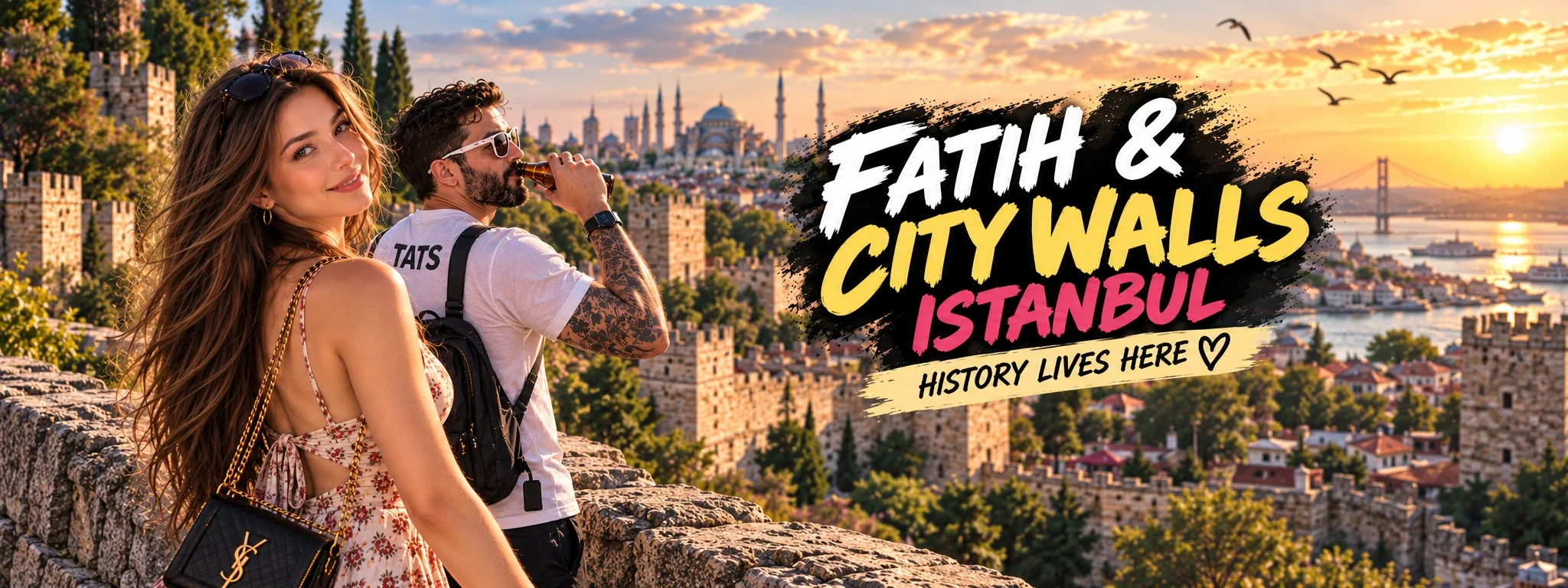
Fatih is where Istanbul's historic peninsula stops feeling like a sequence of headline attractions and starts behaving like a lived-in city. The district is huge, so this guide focuses on the inland Fatih Mosque area and the Theodosian land walls rather than pretending you can “do Fatih” in one neat loop. For me, the payoff is the contrast: Ottoman religious and neighbourhood life on one side, then the scale of Constantinople's fortifications on the other.
Why the land walls matter
UNESCO describes the Theodosian terrestrial wall as a 6,650-metre defensive system whose second line was created in 447. The land-wall component is one of the four protected component areas of the Historic Areas of Istanbul World Heritage Site. That scale is the point: these were not decorative city gates but a layered defensive edge protecting Constantinople for centuries.
Survival is uneven. Some sections are restored, others are fragmented or visually absorbed into modern roads, parks, housing and infrastructure. I would treat the walls as a long archaeological landscape, not as one fenced attraction with a ticket desk and a guaranteed continuous walking path.
Fatih Mosque gives the district its Ottoman centre of gravity
The Fatih Mosque complex sits on the site associated with the Byzantine Church of the Holy Apostles and became one of the defining Ottoman religious complexes after the conquest. The present mosque reflects later rebuilding after earthquake damage, while the wider külliye and the tomb of Mehmed II keep the area important well beyond architecture.
This is an active religious district, not a museum quarter. I dress more conservatively here, keep photography discreet around worshippers and avoid treating a busy mosque courtyard as a backdrop. Our mosque etiquette guide covers the basics.
Do not confuse Topkapı Gate with Topkapı Palace
The name catches plenty of first-time visitors. Topkapı Palace is on the eastern tip of the historic peninsula; Topkapı on the land-wall side is several kilometres west. Metro İstanbul's current T1 tram line includes a Topkapı station, while the M1B metro includes Topkapı-Ulubatlı. Those are useful public-transport anchors for the central wall zone, but check the exact walking approach on the day because roads and restoration areas can interrupt the obvious-looking line on a map.
Pick a wall section rather than chasing every gate
If the walls are your main interest, I would start around a public-transport access point and walk only as far as the street environment remains pleasant and clear. The northern Edirnekapı side can combine naturally with Chora/Kariye and the Fatih-Balat side of the peninsula; the Topkapı area works better when your day is already centred on the inland historic peninsula.
There is no prize for completing all 6.65 kilometres. Traffic crossings, changing restoration access, uneven paving and stretches with limited shade make a selective walk more rewarding than a completionist one.
Allow half a day for a good first visit
For a first visit I would budget roughly three to four hours for Fatih Mosque, neighbourhood wandering and one meaningful wall section. Add Chora/Kariye, Balat or Fener and it becomes a full day. The district rewards pauses in tea houses and ordinary shopping streets; rushing between pins misses the thing that makes it different from Sultanahmet.
Walking conditions are part of the experience
Expect slopes, kerbs, uneven surfaces and major roads near some wall sections. Never climb unstable masonry or cross barriers to get a dramatic photo. Restoration zones can change, and the World Heritage value is precisely why “it looks climbable” is not a sensible access rule.
For reduced mobility, I would plan the mosque and a specific wall viewpoint as separate accessible-route questions. Metro İstanbul notes accessible features on the T1 and M1B networks, but the final street approach around historic fabric can be harder than the vehicle journey itself.
How to get there without overcomplicating it
For the wall side, the T1 Topkapı stop and M1B Topkapı-Ulubatlı are the clearest rail anchors in current Metro İstanbul information. For Fatih Mosque itself, choose the route that minimises uphill backtracking from where you are staying rather than blindly following the wall route first. A taxi can make sense if your priority is the mosque complex and you are short on time.
Best pairings
Chora/Kariye is the most natural heritage pairing on the northern side. Fener and Balat work if you want neighbourhood texture after the walls, while Süleymaniye makes sense if your day is moving back toward the central historic peninsula.
Photography and neighbourhood respect
The walls are photogenic precisely because they sit inside a living city. Photograph masonry and skyline freely from public space, but be careful with residents, children, worshippers and people using cemeteries or mosque grounds. I would rather come home with fewer photos than spend a morning making a residential district feel like a set.
Current sources checked
I checked UNESCO's Historic Areas of Istanbul listing, including its land-wall component and 6,650-metre description, plus Metro İstanbul's current T1 and M1B line information. Restoration and street-level access can change, so treat the exact walking route as a day-of decision.
Cheers, Carpe Diem & let one good wall section beat a six-kilometre box-ticking march! 🍻⏳🏰
TATS Man
taking the long view without needing the longest walk